“Intelligence is the ability to adapt to change.” – Stephen Hawking
This quote captures the essence of Agile methodology. It has transformed the approach to building software. Due to its iterative and fast-paced nature, it is easier to deliver in small increments, make adaptations wherever necessary, and cut down time wasted waiting for client feedback.
The impact of this is seen not just in software development but also in testing. If we look at traditional testing methods, they were not only inflexible but also not iterative – reliant on documentation, phase-gate, and did not really fit with the pace of an Agile environment.
It is in transition that we have witnessed frameworks providing the most value that we can borrow from. One of the most applicable frameworks is the Agile Testing Quadrants. The quadrants are a mental model rather than a strict methodology. They give a basis for considering testing activity in Agile teams. They help teams strike a balance between different forms of tests; they serve to clarify that intent and to make sure that quality is built into the product from various angles.
| Key Takeaways: |
|---|
|
Why Agile Needed a Testing Model
In the traditional waterfall development, testing was usually performed after the whole development of the software was completed and was viewed as a separate and last phase in this process. However, this caused late defect detection, expensive rework, communication gaps between them and everyone else, a lack of ownership about quality across the value stream, and very little responsiveness to change.
Agile transformed development into short rounds of iterations or cycles, as requirements are ever-changing and teams operate in cross-functional fashions. Here, testing was not banished to its terminal seclusion but demanded the instantaneous feedback of every single iteration.
In short, testing needed to become continuous, collaborative, and part of development, but in support of the business. The Agile Testing Quadrants provide a structured framework for all four dimensions of testing (computer-automated, exploratory, technical verification, and business-facing verification).
Read: What is Agile Testing?
The Origin of Agile Testing Quadrants
Brian Marick introduced the concept behind Agile Testing Quadrants, which was further popularized by Lisa Crispin and Janet Gregory in their work on Agile testing practices. Those quadrants were never meant to be a prescriptive checklist or a rigid taxonomy; they’re more of a conversation starter that enables teams to critically assess their testing balance and priorities.
They enable teams to ask important questions around timely verification of business requirements, the right amount of investment in automation, adequate technical verification, and whether user experience is considered sufficiently. The model describes four related categories of testing on two axes: business-facing vs. technology-facing tests and tests that critique the product vs. tests that enable the team.
Understanding the Two Axes
To fully understand the Agile Testing Quadrants, it is necessary to look at the two axes that shape the model. These axes describe perspective and intent, so teams can sort testing based on purpose and audience.
Business-Facing Versus Technology-Facing
This axis defines the primary target audience and point of view for a test. Business-facing tests, for example, use business-familiar language to help confirm if the product meets stated requirements and user expectations.
Technology-facing tests validate the system’s internal correctness from a technical standpoint. They tend to involve programming skills and address implementation-related aspects like logic, structure, integrations, and architecture. Both perspectives are necessary for balanced quality.
A system may look great from a technical standpoint but not satisfy user needs, or satisfy business needs while hiding serious technical weaknesses.
Supporting the Team Versus Critiquing the Product
The intent behind the test is reflected in this axis as well. Supporting tests set the stage for product development by offering fast feedback that helps the team build the product correctly.
Critiquing tests take a different view of a product, looking at readiness, performance, security, and usability all at once. From within this context, these tests often simulate real-world conditions, as it is necessary to determine if a product’s quality expectations meet higher standards than simple correctness.
Supporting tests have a proactive development-oriented focus. Critiquing tests are evaluative and quality-oriented, ensuring the final product truly delivers value and reliability.
The Four Quadrants Overview
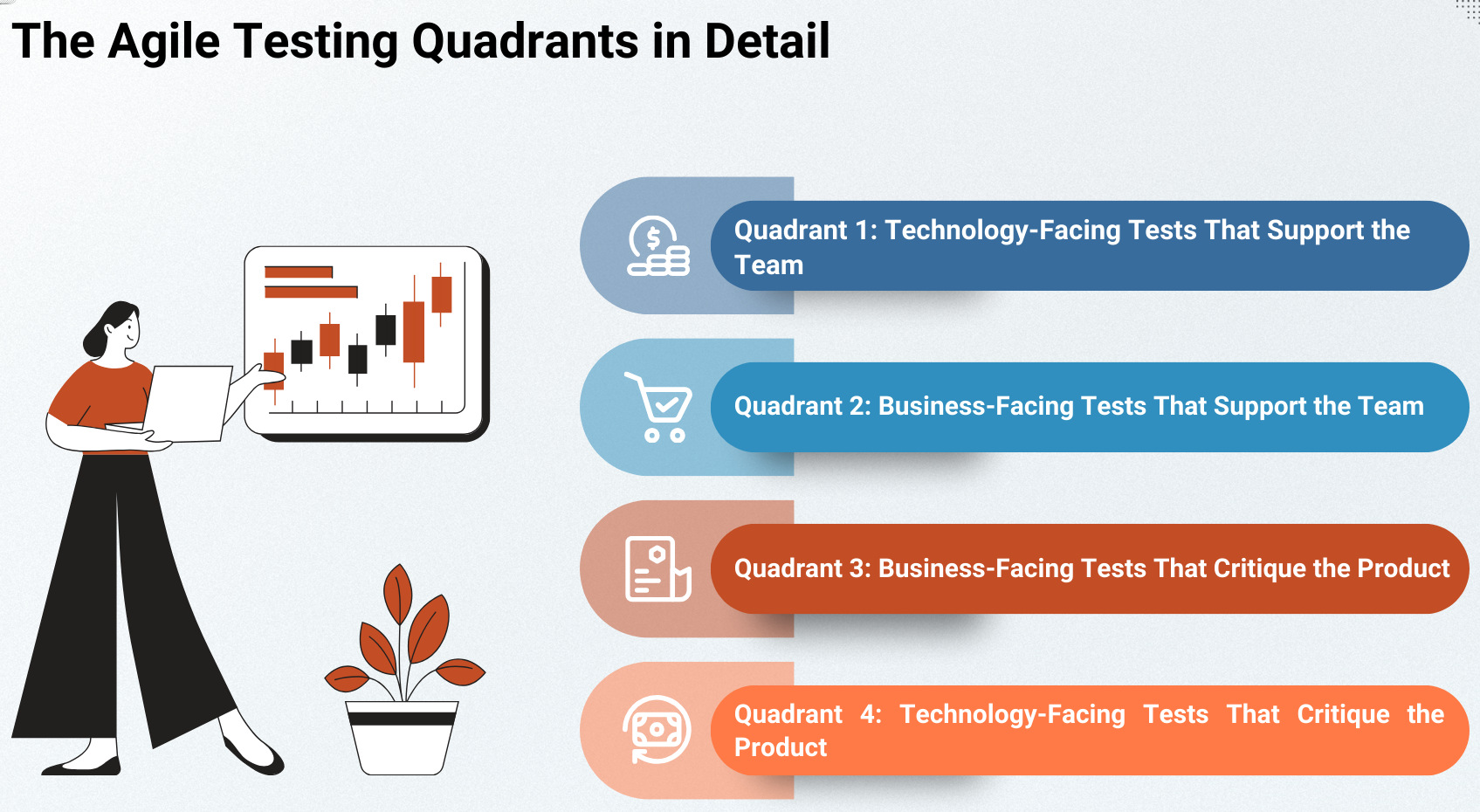
- Quadrant 1: Technology-facing tests that support the team focus on verifying internal code correctness through unit and component tests that provide fast developer feedback.
- Quadrant 2: Business-facing tests that support the team validate business rules and functional requirements early, often through automated acceptance tests and examples that guide development.
- Quadrant 3: Business-facing tests that critique the product evaluate usability, exploratory behavior, and real-world user experience to determine whether the product truly meets customer expectations.
- Quadrant 4: Technology-facing tests that critique the product assess non-functional aspects such as performance, security, scalability, and reliability under realistic or extreme technical conditions.
Read: What is Shift Everywhere Testing? The Future of QA
The Agile Testing Quadrants in Detail
We will now examine each quadrant in detail, exploring its focus, methods, purpose, and how it works together with the others to create balanced and comprehensive testing coverage.
Quadrant 1: Technology-Facing Tests That Support the Team
The first and foremost goal of this quadrant is to support the correctness and stability of the code so that quick and reliable feedback can be provided during the development process. Such tests test each function, class, or component individually to check their correctness, logic, and expected behavior at a granular level.
These tests focus on developers and automated build systems and thus need to be quick and reliable. They assist teams in identifying defects early by providing rapid feedback, thus helping them gain confidence in the evolving codebase.
Core Intent and Characteristics
In this quadrant, we focus on building quality directly into the code by verifying that individual units or components are correctly implemented and behave as expected. Low-level, fast, and highly automated, these tests are designed to identify failures as early as possible, ideally within the developer’s environment, in order to set up a solid foundation on which to build other developments.
Core Practices
- Unit Testing: Validates small and isolated pieces of logic to confirm they produce expected outcomes under defined conditions. Read: Guide to Unit Testing – From Basics to Best Unit Testing Tools
- Component and API Testing: Confirms that modules and services interact properly according to agreed contracts and integration expectations. Read: API Testing Guide: Tools & Techniques for Developers
- Static Code Analysis: Detects syntax problems, vulnerabilities, and structural issues early without executing the application.
- Test-Driven Development (TDD): Encourages writing tests before implementation so that design and code decisions are guided by clearly defined validation criteria. Read: What is Test Driven Development (TDD)?
Why This Quadrant Is Critical
Quadrant 1 forms the technical foundation of Agile testing. Without strong coverage at this level, teams accumulate technical debt quickly and lose confidence in their codebase.
These tests empower developers to refactor and evolve systems safely. In environments driven by continuous integration and rapid release cycles, this level of protection is essential rather than optional.
Read: What is Shift-Left Testing?
Quadrant 2: Business-Facing Tests That Support the Team
The goal of this quadrant is to verify that the system’s functionality matches the defined business requirements. These tests primarily concentrate on story-level and functional validation to confirm that the product behaves as expected from a business perspective.
The intended audience includes product owners, business analysts, testers, and developers who work together to validate results. Since these tests are described in business language, they foster common understanding among technical and non-technical stakeholders.
Core Intent and Characteristics
This quadrant ensures that the system behaves according to stakeholder expectations and agreed acceptance criteria. The tests are derived from user stories and business rules, making them accessible and meaningful to all participants in the delivery process.
They are often written in a clear, domain-oriented format that bridges communication between business and engineering teams. By validating requirements early, they help confirm that development efforts are aligned with customer and organizational goals.
Core Practices
- Functional Testing: Validates complete workflows and feature behavior to ensure the system operates correctly from an end-user perspective. Read: Functional Testing Types Guide
- Acceptance Testing: Confirms that user stories meet defined acceptance criteria before they are considered complete and ready for release.
- Example-Driven Development (EDD): Uses concrete examples to clarify requirements and demonstrate expected system behavior before implementation begins.
- Behavior-Driven Development (BDD): Defines system behavior in a human-readable format, such as Given-When-Then, to align business expectations with technical execution. Read: What exactly is meant by “BDD” (Behavior Driven Development)?
Why This Quadrant Is Critical
In Quadrant 2, the business and engineering departments communicate more effectively, since they work together around common examples and through clear validation criteria. Since requirements can evolve, checking them on an ongoing basis is crucial so that we are not forced to make costly rework. Early feedback ensures that delivered features provide real business value rather than just technical completeness.
Read: What is Build Verification Testing (BVT)? A Complete Guide
Quadrant 3: Business-Facing Tests That Critique the Product
This quadrant’s number one goal, however, is to provide an indication of how the system performs in the real world, while delivering a meaningful and intuitive user experience. These tests seek exploratory and user-centered evaluation to reveal hidden risks, usability gaps, and behavioral inconsistencies.
This audience consists of testers, UX specialists, and other stakeholders serving from the customer perspective. They are supposed to assess the product as end-users would, not merely from a technical, requirement-driven perspective.
Core Intent and Characteristics
This quadrant moves attention away from verification to exploration. Although previous quadrants cover the ways in which the system operates correctly, this one studies how the system functions under unexpected conditions and real usage patterns. It aims to address important issues of usability, relevance, and satisfaction. Rather than testing whether we think expectations are being met, the kind of tests we should be looking at is whether the product actually solves a user’s problems in practical contexts.
Core Practices
- Exploratory Testing: Simultaneously involves learning, test design, and execution to uncover unusual behaviors, hidden defects, and edge-case issues. Read: What is Exploratory Testing?
- Usability Testing: Evaluates how real users interact with the system and measures ease of use, accessibility, and overall satisfaction. Read: What is Usability Testing?
- User Acceptance Testing (UAT): Confirms that the product is ready from the customer’s perspective before release.
- Alpha and Beta Testing: Gathers structured feedback from early users to validate real-world performance and usability prior to full deployment.
Why This Quadrant Is Critical
Quadrant 3 plays a major role in improving customer satisfaction and long-term market success. It introduces a human-centered dimension to testing by validating actual user value rather than theoretical compliance.
By examining how the product performs in real-life conditions, it builds trust and credibility with end-users. This ensures that quality is demonstrated in practice, not just confirmed against documented requirements.
Read: Different Testing Methodologies: A Complete Guide for QA & Developers
Quadrant 4: Technology-Facing Tests That Critique the Product
This quadrant is mainly designed to measure the non-functional capabilities of the system, which include performance, security, scalability, and resilience. Such tests aim at evaluating technical robustness by exposing the system to load, stress, and adverse operational conditions.
Test engineers, DevOps practitioners, system architects, and security specialists are generally the target audience. Their job is to see whether the system can withstand real-world demands and maintain reliability under pressure.
Core Intent and Characteristics
This quadrant looks beyond what the system can do to see how strong and stable it will be. It verifies that, in general operation, even high-volume ones, the product is still reliable, compliant, and secure. The system’s performance under heavy flow or congestion, surprises, and the threat of security issues is scrutinized. They help inform decisions on capacity, vulnerability, recovery capability, and operational resilience
Core Practices
- Performance and Load Testing: Measures response times, throughput, concurrency limits, and system behavior under increasing user load. Read: Performance Testing: Types, Tools & Challenges
- Security Testing: Identifies vulnerabilities and potential attack vectors while ensuring compliance with established security standards. Read: What is Security Testing: How to Do, Types, and Tools
- Disaster Recovery and Failover Testing: Verifies that the system can recover from critical failures and maintain continuity through backup mechanisms.
- Compatibility Testing: Ensures consistent behavior across different browsers, devices, operating systems, and environmental configurations. Read: What is Compatibility Testing?
Why This Quadrant Is Critical
In modern digital systems, performance and security are fundamental trust factors rather than optional enhancements. This quadrant ensures that the product can handle real-world usage demands and withstand potential threats. It creates trust for the users, stakeholders, and the technical teams by validating such durability and stability. A system that performs reliably under pressure earns long-term credibility and market trust.
Read: Shift-Right Testing: Guide to Testing in Production
How the Quadrants Work Together
The four Agile Testing Quadrants are closely related, not individual categories. They operate like a continuous system, which reinforces the idea that Agile testing should be cyclical, relying on frequent feedback. Quadrants 1 and 2 are preventive, guiding teams in creating the product correctly by making sure it has code quality and alignment with business requirements at the start. On the other hand, Quadrants 3 and 4 are evaluative, looking at the final product in terms of real-world value, usability, performance, and resilience.
Overall, these four quadrants depict a 360-degree perspective on quality, covering a continuum from pure technical requirements to customer satisfaction. This unified view guarantees that internal correctness and external impact are handled to the point. A user experience testing result from Quadrant 3 can lead to improvements in acceptance criteria and functional validations within Quadrant 2, for example.
Similarly, performance or scalability concerns found in Quadrant 4 may elicit refactoring actions and bolster low-level validations in Quadrant 1. This creates an interdependent structure that allows for a continuous feedback loop to happen at all levels of testing. Thus, quality is a continuous journey of learning, adaptation, and enhancement, which is at the center of Agile techniques.
Read: Benefits of Automation Testing
Organizational Value of the Agile Testing Quadrants
The Agile Testing Quadrants are not merely a framework for categorizing tests, but a model that reshapes how organizations think about quality. They encourage teams to treat testing as an integrated and continuous activity within development rather than a separate phase that is completed at the end.
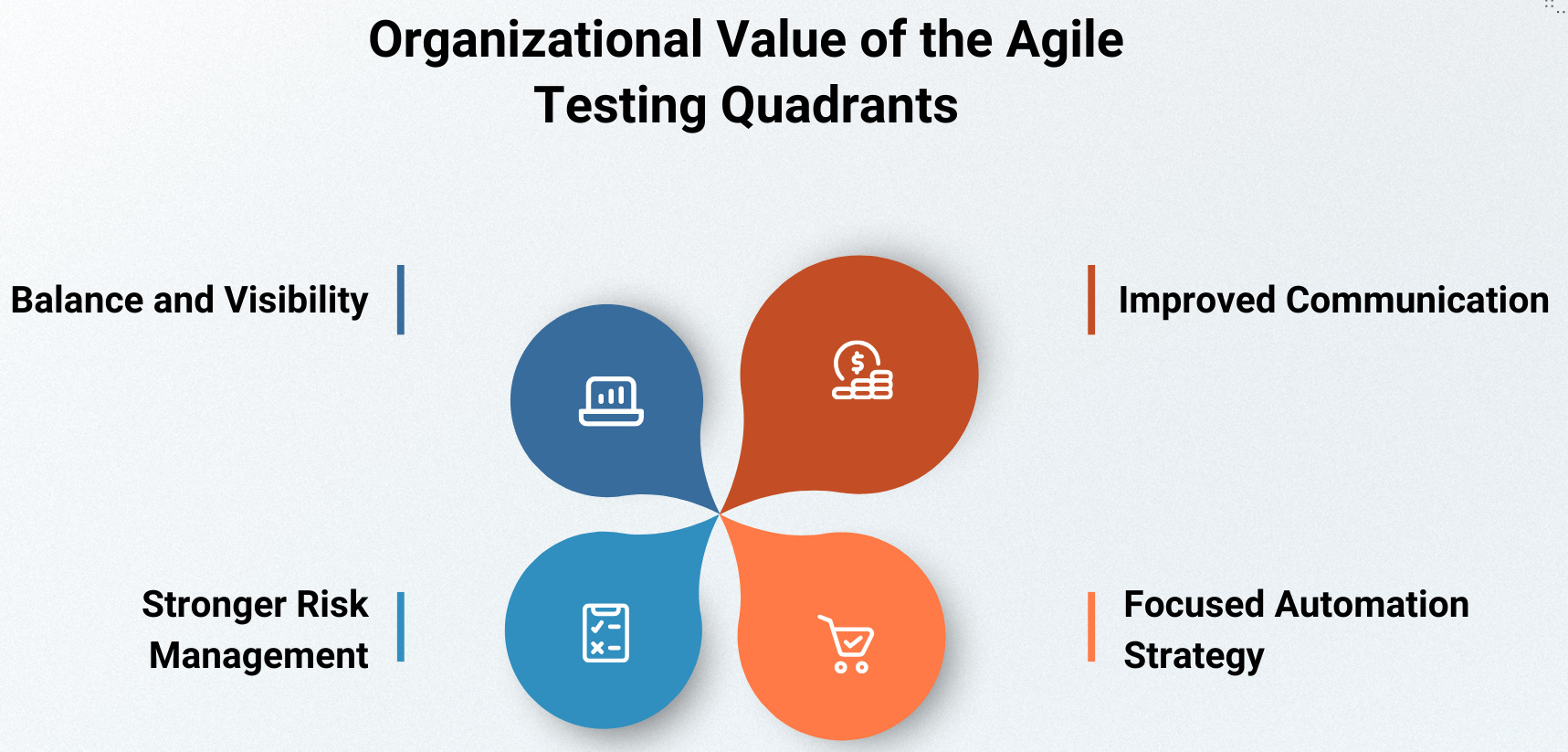
- Balance and Visibility: The quadrants highlight where testing efforts are concentrated and where gaps may exist. They make it easier to identify imbalances, such as overemphasis on unit testing while neglecting user experience, which can ultimately weaken overall quality.
- Improved Communication: The model establishes a shared vocabulary between business and technical teams. Instead of debating abstract testing types, teams can reference specific quadrants to clarify intent and expectations quickly.
- Stronger Risk Management: Each quadrant addresses different categories of risk, including functional defects, usability issues, performance limitations, and system vulnerabilities. Comprehensive quality management requires attention across all four areas to reduce exposure effectively.
- Focused Automation Strategy: The quadrants also guide decisions about where automation delivers the greatest value. Typically, Quadrants 1 and 2 benefit from strong automation, while Quadrants 3 and 4 often rely more heavily on exploratory evaluation and specialized technical assessments.
Conclusion
The Agile Testing Quadrants offer a useful mental model, one that helps teams view quality from multiple, balanced perspectives rather than a single testing-based approach. The quadrants cover everything that matters: technical correctness, business alignment, user experience, and non-functional resilience to ensure quality in development is built, validated, and continuously improved throughout the development lifecycle. Properly adopted, they evolve testing into a collaborative, strategic exercise that strengthens both product reliability and customer trust.