In the modern digital era, businesses operate within complex digital ecosystems, where IT teams face unprecedented operational challenges. Today’s applications are multi-cloud, distributed, containerized, and highly dynamic. Monitoring logs, events, traces, and performance metrics has multiplied in volume and complexity. Human operators can no longer keep up with this, and traditional monitoring systems and tools struggle to deliver visibility or actionable insights at scale.
Artificial Intelligence for IT Operations, or AIOps, is a technology that has emerged rapidly and can help enterprises address the above situation by assisting in the management, monitoring, and optimization of their IT environments.
AIOps is a combination of Artificial Intelligence (AI) and Operations (Ops), representing the merging of AI and IT Operations (ITOps). It refers to multi-layer tech platforms that use machine learning (ML), data analytics, data science, automation, and observability to identify and resolve IT operations issues.
AIOps delivers smarter, faster, and more autonomous IT operations, enabling organizations to proactively detect anomalies, predict incidents, automate root-cause analysis, and reduce manual efforts. With this, system reliability, performance, and business continuity are improved.
Let us explore AIOps in more detail, understanding what it is, why it matters, how it works, its key capabilities, real-world use cases, and how organizations can effectively adopt it.
What is AIOps?
Gartner initially coined the term AIOps as “the use of big data, analytics, and machine learning to improve and partially replace a broad range of IT operations processes.”
It is the application of AI capabilities, such as natural language processing and machine learning models, to automate, optimize, and streamline IT service management and operational workflows.
- Analyze and aggregate the vast (and ever-increasing) volumes of data generated by IT components, application demands, performance monitoring tools, and service ticketing systems in an enterprise tech stack.
- Identify significant events and patterns related to application performance and availability issues by intelligently shifting signals out of the “noise”.
- Diagnose root causes and report them to IT and DevOps for rapid incident response and remediation, or even resolve them without human intervention.
- Infrastructure monitoring
- Application performance management (APM)
- Incident and event management
- Log analytics
- Capacity planning and forecasting
- Automation and orchestration
In simple terms:
AIOps = Observability + AI/ML + Automation → Smarter, proactive IT operations
Why AIOps Is Becoming Essential
AIOps is gaining importance because modern IT environments have become too fast, distributed, and complex for manual processes and traditional monitoring tools. Here are the primary reasons AIOps is becoming essential:
Explosive Growth of IT Data
Modern systems generate enormous amounts of operational data, including logs, events, traces, metrics, and more, which are impossible for humans to process manually. AIOps platforms aggregate and analyze this big data to extract meaningful and actionable insights.
Increasing System Complexity
Organizations now rely on multi-cloud environments, Kubernetes and container orchestration, microservices architectures, serverless functions, and edge computing to create a highly dynamic and complex web of interdependencies that traditional monitoring tools cannot manage. AIOps uses ML to understand these relationships and provides end-to-end visibility.
The Need for Faster Incident Response
Businesses require high availability and minimal downtime, as disruption can be costly. AIOps reduces the Mean Time to Detect (MTTD) and Mean Time to Resolve (MTTR) by providing early warning signals and automated diagnostics. It also accelerates incident detection and resolution, preventing issues that impact end-users and thereby improving the customer experience and reliability.
Talent Shortages and Burnout
Alert fatigue (thousands of alerts sent by monitoring tools), manual analysis, and 24/7 on-call duties can overwhelm even experienced teams. AIOps uses intelligent correlation and noise reduction techniques to reduce these burdens by automating routine tasks and intelligently prioritizing issues.
Demand for Operational Resilience
Businesses today seek systems that are self-healing, predictive rather than reactive, and autonomous to enhance operational resilience. AIOps provides all three functions and forms the backbone of this switch.
How AIOps Works
AIOps uses big data, machine learning (ML), and automation to collect and aggregate massive amounts of IT operational data, analyze it to identify patterns and anomalies, and then proactively or automatically resolve issues. Before understanding the working of AIOps, let us examine the core components of AIOps.
Core Components of AIOps
The core components of AIOps are data collection, machine learning, analytics, and automation, which work together to observe, engage, and act on IT operational issues. Additionally, AIOps includes visualization tools as a key component.
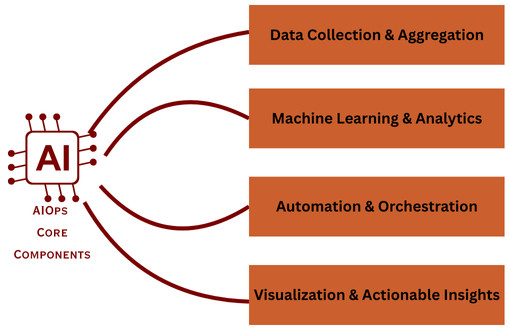
- Data Collection and Aggregation: AIOps platforms collect and consolidate vast volumes of diverse data (logs, metrics, events, traces, and incident data) from across the entire IT environment, including on-premises systems and multi-cloud platforms. This data is then centralized and normalized to generate a unified view.
- Machine Learning and Analytics: This is the “brain” of AIOps. Advanced algorithms are applied to the aggregated data for the following purposes:
- Pattern Recognition & Anomaly Detection: ML models learn what “normal” behavior looks like and automatically detect significant deviations that might indicate a problem.
- Event Correlation & Root Cause Analysis: The platform identifies and links related events across different systems and layers, such as an application slowdown or a database error, to pinpoint the actual cause of an issue, rather than just its symptoms. This significantly reduces alert noise and false positives.
- Predictive Insights: AIOps forecasts future problems, such as resource exhaustion or potential hardware failures, by analyzing historical data and trends, thereby preventing them from impacting users.
- Automation and Orchestration: AIOps triggers automated responses with minimal human intervention, based on insights generated by analytics. This can include:
- Automated Remediation: Predefined scripts, also known as “runbooks,” are executed to resolve common issues, such as restarting a service or scaling up resources.
- Intelligent Alerting and Workflow Management: Contextual, prioritized incidents are directed to the appropriate teams (e.g., security, networking) and seamlessly integrated with existing IT Service Management (ITSM) tools, such as ServiceNow or Splunk.
- Visualization and Actionable Insights: AIOps platforms offer dashboards and reports that present complex data in clear, visual formats. This enables IT teams to monitor system health, understand the business impact of issues, and make data-driven decisions.
By integrating these core components, AIOps shifts IT operations from a reactive, manual approach to a proactive and predictive one, resulting in faster incident resolution, reduced downtime, and improved operational efficiency.
AIOps Workflow
The AIOps process generally follows a continuous intelligence loop with several key stages:
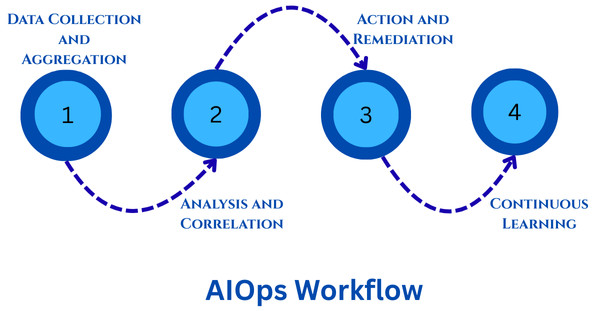
- Data Collection and Aggregation
- AIOps platforms collect vast volumes of data from all across the IT environment, breaking down traditional data barriers. The following data is collected:
- Historical performance and event data
- Real-time operations events
- System logs and metrics
- Network data, including packet data
- Incident-related data and ticketing
- Application demand data
- Infrastructure data
- The AIOps platform normalizes and enriches this raw, often unstructured, data into a unified, consistent format for analysis.
- AIOps platforms collect vast volumes of data from all across the IT environment, breaking down traditional data barriers. The following data is collected:
- Analysis and Correlation: this stage includes the following
- ML algorithms process the aggregated data in real-time and historically.
- Noise Reduction: Redundant or low-priority alerts (noise) are filtered out, focusing on significant events.
- Anomaly Detection: ML models establish a benchmark of normal behavior and flag deviations that may indicate potential problems or security threats.
- Event Correlation: Related events across different systems are connected to pinpoint a single underlying cause, rather than multiple symptoms.
- Root Cause Analysis: AIOps performs in-depth analysis of patterns and dependencies to identify the true origin of a problem, so that teams can avoid time-consuming manual troubleshooting.
- Action and Remediation
- Once analyses are completed, the AIOps platform can initiate automated responses or provide actionable insights and recommendations to IT teams based on the analysis results.
- Automated Remediation: If issues are common and predefined, AIOps can trigger automated workflows, such as restarting a service, scaling resources, or rolling back a problematic software update, often before users are impacted.
- Intelligent Alerting: Context-rich alerts and potential solutions are routed to the appropriate IT teams when human intervention is needed. Collaboration tools like Slack and PagerDuty are used for this purpose.
- Continuous Learning: The AI models are retrained continuously using new data and the outcomes of previous actions, refining their accuracy and improving their ability to detect and predict future issues. Systems adapt to the dynamic and evolving IT environment using these feedback loops.
This AIOps workflow helps organizations shift from a reactive to a proactive approach and ultimately, a predictive and autonomous mode of operations.
Use Cases for AIOps
AIOps is used across industries and IT functions. Some of the most valuable use cases include:
Proactive Incident Detection
AIOps detects and responds to incidents before they impact users. This automated incident response allows for highly accurate identification, diagnosis, and remediation, much more quickly than is possible with human operators.
Application Performance Monitoring (APM)
IT teams use APM to proactively detect performance anomalies, optimize application response times, and ensure that user experiences are consistently high quality. AIOps, through AI and ML algorithms, predicts potential issues before they affect users, facilitating a more resilient and responsive IT infrastructure.
Predictive Maintenance
AIOps is used in predictive maintenance to forecast future failures (e.g., disk, network, and memory anomalies). AIOps’ data collection and analysis capabilities employ ML to current and historical data trends, creating highly accurate forecasts of future outcomes.
Root-Cause Analysis (RCAs) Acceleration
RCAs determine the root cause of problems to remediate them with appropriate solutions. It helps teams avoid the counterproductive work of treating symptoms of an issue, instead of the core problem.
For example, when a network outage occurs, an AIOps platform can trace its source to resolve it immediately and set up safeguards to prevent the same problem from occurring in the future.
Capacity Planning and Optimization
AIOps can predict growth patterns and optimize resource allocation by analyzing usage trends. This way, organizations can also plan for future needs.
Anomaly Detection
AIOps tools can analyze large amounts of historical data and discover atypical data points within a dataset. With these outliers, teams identify and predict problematic events (data breaches, for instance) and avoid the potentially costly consequences of those events, such as negative PR, regulatory fines, and declines in consumer confidence, among other issues.
Cloud Adoption and Migration
AIOps provides clear visibility into interdependencies in hybrid multicloud environments and can dramatically reduce the operational risks associated with cloud migration and hybrid cloud approaches.
DevOps Adoption
IT teams receive required visibility and automation from AIOps to support DevOps without excessive human oversight.
Benefits of AIOps
- Faster Mean Time to Repair (MTTR): AIOps cuts through IT operations noise and correlates operations data from multiple IT environments, identifies root causes, and proposes solutions faster and more accurately than humanly possible. This accelerated problem identification and incident resolution processes result in faster MTTR.
- Lower Operational Costs: AIOps automatically identifies operational issues and reprogrammed response scripts reduce operational costs and drive more precise resource allocation. This way, the IT staff workload is reduced, and resources are freed up for more innovative and complex work.
- Better Observability and Collaboration: AIOps monitoring tools result in more effective collaboration across DevOps, ITOps, governance, and security teams. Better visibility, communication, and transparency enable these teams to improve decision-making and respond to issues faster.
- Predictive ITOPs Management: AIOps has built-in predictive analytics capabilities, and continuously learn to identify and prioritize the most urgent alerts. IT teams can thus address potential problems before they lead to unplanned downtime, disruptions, and service outages.
- Streamlined Operations: AIOps collects data from various sources into a unified framework, reducing the inefficiency of manual data analysis and minimizing human error.
- Proactive Problem-solving: By performing anomaly detection and providing actionable insights, AIOps allows IT teams to address issues before they impact users.
Implementing AIOps
The following are the key steps included in AIOps implementation:
1. Plan and Strategize
- Define clear goals: Set clear and specific objectives like reducing the mean time to resolution (MTTR) or eliminating alert fatigue.
- Audit current toolchain: Map out existing tools and data flow to identify gaps, overlaps, and data barriers.
- Align with business strategy: Ensure the AIOps initiative supports key business objectives, such as customer satisfaction or revenue growth.
- Promote cross-functional collaboration: Break down barriers between IT operations, development, and other business units to ensure the project is aligned with organizational goals.
2. Prepare Data and Platform
- Choose the right platform: Select a platform that integrates with your environment, supports real-time data collection, and provides customizable workflows.
- Integrate data: Collect and unify data from various sources like servers, applications, and networks to create a single, holistic view.
- Clean up and enrich data: Before full automation, clean up noisy inputs. Standardize and enrich raw data with relevant context to make it more actionable.
- Centralize data: Create a centralized data lake so ML models have all the necessary data to identify patterns and behaviors.
3. Implement and Scale
- Start with a pilot project: Begin with a single team, system, or workflow to prove value and identify what needs improvement.
- Reduce alert noise: Use AI-driven filtering to group related incidents and highlight critical alerts, reducing the impact of alert fatigue.
- Implement automation: Set up automated responses to known issues to fix them before they impact users.
- Build feedback loops: Set mechanisms for continuous feedback and improvement.
- Scale gradually: Once the pilot is successful, expand AIOps to other environments and use cases.
AIOps vs. DevOps
AIOps uses AI to automate and analyze performance in real-time to enhance IT operations. DevOps is an approach consisting of a set of cultural and process principles focused on accelerating software delivery.
The following table summarizes the key differences between AIOps and DevOps:
| Aspect | AIOps | DevOps |
|---|---|---|
| Focus | Focuses on operational aspects, especially monitoring and managing large-scale IT environments after deployment. | Focus is on the entire software delivery lifecycle, from development to deployment. |
| Goal | Uses AI and ML to analyze operational data, detect issues, diagnose root causes, and automate responses, improving stability and efficiency. | Breaks down barriers between development and operations teams, enabling faster, more frequent releases through collaboration and automation. |
| Key principles | Uses Big Data and AI for automation, anomaly detection, and intelligent insights in IT operations. | Involves Continuous Integration, Continuous Delivery (CI/CD), automation, and a collaborative culture. |
| Key tools | Tools and platforms that use ML and big data analytics. | Jenkins, Docker, Kubernetes. |
AIOps Tools
AIOps tools use AI and ML to automate and improve IT operations by collecting and analyzing data from various data sources to detect issues, find root causes, and automate remediation.
The following table shows popular AIOps tools in use:
| Tools | Details |
|---|---|
| Dynatrace | Full-stack observability, automated discovery, and AI-driven analytics. |
| Moogsoft | Alert correlation, incident triage, and ML-based classification. |
| LogicMonitor | Hybrid infrastructure monitoring and anomaly detection. |
| Splunk ITSI | Service-level monitoring, RCA, and business impact analysis. |
| PagerDuty | Incident response, on-call scheduling, and intelligent automation for rapid response. |
| New Relic | AIOps solutions for DevOps and SRE teams to reduce noise and find problems more efficiently. |
Challenges in AIOps
- Data Quality Issues: Data quality is important in AIOps. Poor data quality limits AI’s effectiveness and, in turn, impacts AIOps.
- Organizational Resistance: Teams may fear loss of control or job displacement as a result of AIOps adoption.
- Tool Sprawl: There are too many isolated monitoring tools that dilute clarity.
- Trust in Automation: Teams may not have full faith in automation. They gradually build confidence in automated actions.
- Complexity of Integration: AIOps solutions integrate with diverse legacy and cloud systems, making integration complex.
The Future of AIOps
- Autonomous IT Operations: Most of the IT operations tasks will be handled by systems without human intervention.
- AI-Powered DevOps Pipelines: AI will be assisting CI/CD automation, QA, and deployment validations.
- Predictive Business Operations (BizOps): AIOps providing insights informing business decisions beyond IT.
- Deeper Integration With Observability Platforms: AI-native observability is becoming a standard.
- Generative AI for Ops: Large language models (LLMs) will enable conversational troubleshooting, dynamic runbook creation, and predictive guidance. GenAI and AIOps will redefine operational intelligence.
Conclusion
AIOps is a critical evolution in how modern organizations manage highly complex digital ecosystems. By combining AI, ML, automation, and observability, AIOps enables IT teams to transition from reactive firefighting to proactive, strategic, and autonomous operations.
As digital transformation accelerates and infrastructure becomes increasingly distributed and dynamic, AIOps will become essential for enterprises seeking resilience, agility, and a competitive advantage.