
In modern software development, there is always a race to deliver features faster, reduce time-to-market, and remain competitive in an ever-evolving digital environment. However, with speed comes compromise, especially in testing. To offer faster, teams may skip tests, write minimal tests, delay automation, or choose quick fixes—these shortcuts, when accumulated over time, result in what is known as Test Debt.
Test debt is one of the most undervalued yet costly types of technical debt. Unlike bugs that visibly disrupt the application flow, test debt quietly erodes the stability, velocity, and confidence of teams over time. It hides in outdated automation scripts, incomplete test suites, missing negative scenarios, or unmaintained test environments.
Test debt is one of the most under-recognized yet costly forms of technical debt. Unlike bugs that are visible and disruptive, test debt quietly erodes the stability, velocity, and confidence of engineering teams. It accumulates in gaps and compromises in software testing, such as incomplete test suites, outdated automation scripts, missing negative scenarios, and unmaintained test environments. By the time the impact is felt, damage is already evident in the form of unstable releases, longer QA cycles, higher maintenance costs, and unpredictable quality.
This article examines test debt in detail, including its sources, symptoms, impact, and strategies for reducing it.
What Is Test Debt?
Test debt is the accumulation of deficiencies and compromises in the testing process that result from shortcuts, omissions, or outdated practices. It is a type of technical debt, but it focuses specifically on the testing ecosystem, test automation, test coverage, documentation, processes, and test infrastructure.
In simple terms, test debt is the gap between the tests actually available today and the tests you should have to ensure software quality. This is like you expect something to be worth a certain amount, but it’s actually worth less.
Think of it as a financial debt you never knew you had, and now you have to work hard to pay it off to get things in order.
Test Debt vs. Technical Debt
Test debt is similar to technical debt, as it is a metaphorical weight that accumulates due to postponement or compromise in testing during software development. If not addressed on time, it needs extra efforts to fix, update/improve, or add tests. In software development, debt accumulates when you rush to complete tasks, thinking you will address the issues later. Technical debt arises when developers take shortcuts to expedite development, but these shortcuts cause problems or deficiencies. This is the technical debt that eventually you have to go back and pay off (meaning fix things that were rushed).
While technical debt accumulates in development, test debt accumulates in testing. Like technical debt, test debt also hinders quality and project progress. If it is postponed repeatedly, minor issues can eventually become significant problems that may be complicated to resolve.
Why the Term “Debt”?
- It Accumulates Interest: The longer the test debt goes unnoticed and unaddressed, the more costly it becomes to fix.
- It Slows Progress: As test debt accumulates, teams spend more time debugging, re-testing, and performing manual checks. This slows overall project progress.
- It Risks Catastrophic Failure: Just like missed payments may have grave consequences, ignored test debt can lead to system breakdowns, severe regressions, or customer-facing incidents.
Organizations must prioritize the work needed to maintain healthy quality practices by recognizing testing shortfalls as a form of “debt.”
Common Causes of Test Debt
Test debt does not accumulate from a single source but from multiple contributing factors. Here are the most common ones encountered across teams.

Insufficient Test Coverage
- Strict deadlines.
- Overworked QA teams.
- Poor planning of the testing phase.
- Lack of automation expertise.
- Rushed releases.
Initially, it may seem harmless to skip tests, but over time, it creates large blind spots. Appropriate planning could prevent many of these issues.
Outdated or Broken Test Scripts
- Frequent UI changes.
- Deprecated APIs are used in code.
- Flaky tests are tolerated for too long.
- Complex and fragile test code.
Due to broken tests, teams are forced back to manual testing with decreased trust in automation.
Flaky Tests
- Developers rerun pipelines multiple times to verify the tests.
- QA teams waste hours diagnosing false failures.
- Flaky results mask real issues.
Unstable environments, race conditions, poor synchronization, or non-deterministic data often cause flakiness.
Reliance on Manual Testing
Manual testing is valuable, but relying too heavily on it, especially for repetitive regression tests, creates inefficiency. When manual tests replace automation, regression cycles grow longer, and releases become slower.
Poorly Designed Test Cases
- Testers interpret requirements differently.
- Documentation is out of sync with product behavior.
- Tests become redundant or contradictory.
Lack of Testing Standards or Guidelines
- Test naming conventions.
- Required levels and percentage of test coverage.
- Clear automation strategy.
- Reviewing tests.
Without the standards and regulations, the tests designed are structured poorly, resulting in inconsistent quality and disorganized test assets.
Missing Negative, Edge, or Real-World Scenarios
- Negative testing
- Security testing
- Load testing
- Stress or boundary scenarios (Edge cases)
- Usability tests
Skipping these scenarios directly translates into test debt.
Inadequate Test Infrastructure & Resources
Poor test infrastructure, such as slow pipelines, unstable environments, or poorly managed test data, causes delays and unreliable results. Over time, teams opt for creating workarounds instead of solving the root cause, increasing test debt further.
A lack of, or a sudden change in, resources is also a common cause of test debt. In case the ratio of testers to developers is unbalanced through resignations or layoffs, testers can become overwhelmed by the amount of work assigned to them.
Signs of Test Debt
- Increasing Release Cycle Duration: When testing takes longer with every release, it’s an indication that teams rely too heavily on manual testing or take a long time to troubleshoot automated tests.
- Frequent Production Bugs or Regressions: There are bugs found in production frequently. This means there is a test coverage gap, and these bugs were not caught early enough.
- Rising Flakiness and Unreliable Automation: Tests may pass or fail at random, resulting in flaky tests. These undermine confidence in the automated pipeline, and teams tend to ignore test results.
- Difficulty Onboarding New QA Engineers: Onboarding of new members becomes difficult, and the learning curve turns steep due to a cluttered test suite with inconsistent patterns, missing documentation, and outdated scripts.
- Reduced Developer Confidence in CI/CD Pipelines: Pipelines fail unpredictably or take too long, deployments slow down, and developers circumvent them, signaling test debt that is running deep.
- QA Teams Becoming Bottlenecks: As test debt limits automation effectiveness, QA is forced to manually verify each release.
The Impact of Test Debt in QA
We discussed the symptoms that frequently occur when there is test debt in the system. If you keep ignoring these symptoms, test debt has far-reaching consequences. Some are financial, others operational, and many cultural. Here are the consequences of ignoring test debt:

Reduced Engineering Velocity
Due to test debt, teams spend more time debugging issues, retesting existing features manually, and rewriting broken automation. These actions take a lot of time and delay other tasks, resulting in missed deadlines.
Lower Product Quality
Test debt reduces the overall software quality and could degrade the user experience and damage the product or organization’s reputation.
Higher Production Costs
Fixing bugs in production is much costlier than preventing them or fixing them during development. It takes resources and time to identify, diagnose, and rectify defects that surface after releasing the product. The fixes provided may include urgent bug fixes, hotfix deployments, or potential damage control that significantly affect the project’s budget and timeline.
Team Burnout
Unreliable test results, constant firefighting, and long regression cycles create significant pressure and frustration on QA and engineering teams. This negatively impacts overall team morale, impacting project outcomes. When such incidents occur frequently, team members may raise concerns about workflow efficiency or tools used. This leads to decreased productivity, reduced job satisfaction, lower performance, and reduced motivation to provide quality work.
Poor Risk Management
Without proper testing, teams have limited visibility into the stability of their products. Releases become risky, and rollback frequency increases. Post-production bugs may affect user satisfaction.
Strategic Limitations
Businesses with high test debt struggle to adopt continuous delivery, scale engineering teams, and modernize architecture. They also struggle to run experiments safely, resulting in poor innovation. Overall, test debt hinders the strategic development of organizations.
How to Identify and Measure Test Debt
Fixing test debt needs proper visibility. Organizations must establish metrics, processes, and tools to assess the current state of testing.
Key Metrics for Test Debt
The following table shows useful quantitative indicators that provide valuable inputs:
| Quantitative Indicator | Purpose |
|---|---|
| Automation Coverage Percentage | How much of the application is covered by automated tests? |
| Test Execution Time | Are regression cycles expanding? |
| Number of Flaky or Disabled Tests | How many tests are flaky or disabled? |
| Defect Leakage Rate | Ratio of bugs found in production vs. those found in QA. |
| Mean Time to Detect (MTTD) | Long detection times indicate gaps in observability or test coverage. |
| Mean Time to Repair (MTTR) | High MTTR indicates a lack of robust testing around the failure area. |
| Test Case Redundancy or Obsolescence | Outdated tests signal neglected test suites. |
Qualitative Assessment
- Areas of high complexity or frequent change.
- Known fragile or brittle tests.
- Missing test coverage in core workflows.
- Challenges faced by testers during releases.
- Whether test documentation is up to date.
Test audits, retrospectives, or quality workshops are some of the means by which this assessment can be done.
Test Debt Backlog
Many organizations create a Test Debt Register or Backlog, listing the following information:
- Identified test gaps.
- Prioritized fixes.
- Estimated effort required.
- Owners and deadlines for each issue.
Similar to technical debt backlogs, test debt backlog provides visibility and drive accountability.
Test Debt Remediation Strategies
Reducing or completely eliminating test debt requires planning, investment, and cultural alignment. Here are some of the effective strategies to reduce test debt:
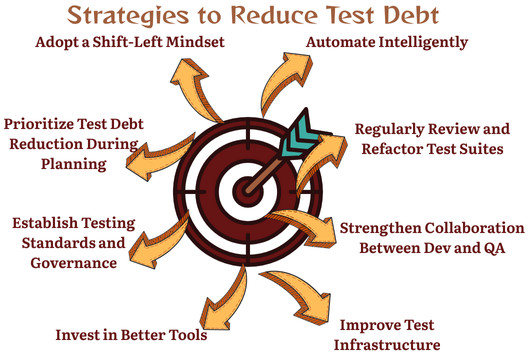
1. Adopt a Shift-Left Mindset
- Writing unit tests during the development phase.
- Validating requirements and acceptance criteria early.
- Using static analysis and linting tools.
This approach reduces bugs before they enter the codebase.
2. Automate Intelligently
- High-priority workflows to be tested.
- High-risk areas prone to bugs.
- Repetitive or time-consuming tasks that should be executed frequently.
- End-to-end scenarios that matter to end users.
AI-powered tools enable non-technical teams to create stable, AI-driven end-to-end tests quickly, significantly reducing test debt from brittle automation.
3. Regularly Review and Refactor Test Suites
- Remove or merge redundant tests.
- Fix flaky tests immediately to avoid confusion and waste of time.
- Regularly update outdated automation scripts.
- Improve naming conventions and the structure of tests.
Scheduled maintenance sprints, also known as “test cleanup days,” can help keep test suites healthy.
4. Strengthen Collaboration Between Dev and QA
- Developers’ participation in test creation.
- QA participation in requirements refinement.
- Pair programming and test writing sessions.
- Shared coverage goals.
The more aligned the various teams are, the lower the debt will be.
5. Improve Test Infrastructure
- Reliable CI/CD pipelines.
- Dedicated test environments.
- Test data management systems.
- Parallel test execution to shorten cycles.
Automation is only as strong as the environment in which it runs.
6. Invest in Better Tools
Old, legacy tools often contribute to debt. Modern testing tools enhance reliability, reduce maintenance, and enable teams to scale testing more efficiently. AI-based no-code automation platforms dramatically reduce maintenance burdens.
7. Establish Testing Standards and Governance
- Minimum test coverage.
- Required types of testing (unit, API, E2E).
- Test case structure.
- Documentation requirements.
- Approval processes.
Standardization reduces inconsistencies and prevents new debt from accumulating.
8. Prioritize Test Debt Reduction During Planning
Teams should actively set aside time for fixing flaky tests, increasing coverage, and updating outdated test assets. This should be done during the planning phase itself so that the required time is incorporated in the project schedule.
Preventing Test Debt from Accumulating Again
-
Make Testing Part of the Definition of Done (DoD): A feature is not complete unless it satisfies the following conditions:
- All required automated tests exist.
- All tests pass.
- Documentation is updated.
- No new flakiness is introduced.
Only when all conditions pass, the quality is ensured. -
Automate Test Debt Monitoring: Use real-time dashboards to monitor metrics such as:
- Coverage trends
- Rising flakiness
- Test failures over time
- Pipeline duration
Set alerts to help teams respond immediately. -
Set a “No Ignoring Flaky Tests” Rule: Flaky tests should be considered as production incidents that are either fixed immediately or disabled and added to the test debt backlog.Pipelines should never be allowed to continue with unknown failures.
-
Encourage a Quality-First Culture: Encouraging a culture that values quality prevents shortcuts that lead to test debt.
Conclusion
Test debt is a byproduct of fast-moving software development, but it need not hinder product quality or velocity. When teams recognize the sources of test debt and understand their impact, they can systematically identify and reduce them. The key to this is visibility, prioritization, and ongoing investment in testing best practices.
With modern, stable automation tools, teams can drastically reduce test debt and build sustainable, scalable testing frameworks.