
Software as a service (SAAS) has revolutionized the software development process significantly over the past decade. No longer are there long release cycles to continuous delivery. No more siloed teams and cross-functional squads. From manual regression suites to AI-powered automation, we ‘ve come a long way. And yet, for all of that change, many organisations still treat testing as a second-class concern – something to do in the end, or something left for QA. That strategy will not work anymore.
With more and more complex software architectures in the age of distributed tech, microservices, APIs, AI-driven features, and mobile plus web platforms, testing it all at scale has become tedious. It ‘s no longer about writing test cases or automating UI flows. It’s about managing your environment, managing your data, managing your pipeline, infrastructure, reporting, observability, quality metrics, and release governance.
And this is where TestOps comes in. TestOps is not just a buzzword. It is a structural shift in how organizations approach quality at scale. It combines testing with operational discipline, automation infrastructure, continuous integration, environment orchestration, and data-driven decisions.
The Evolution Toward TestOps
Software testing has moved from a late-stage validation phase into an ongoing, fully integrated discipline throughout the entire delivery lifecycle. When systems matured and release cycles accelerated, organizations realized that operational responsibility should be extended to the whole testing ecosystem, leading to the birth of TestOps.
- Traditional Testing Era: In the earlier waterfall approach, testing was considered the final stage at the end of the development cycle, before any release of the software. Processes were sequential, the environment static, and regression cycles long, so feedback was slow and automation fragile.
- Agile Testing Era: Agile brought testing earlier into the development lifecycle, encouraging collaboration between developers and QA within sprints. While automation increased, instability in environments, inconsistent test data, and fragmented reporting often limited true operational efficiency.
- DevOps Revolution: DevOps accelerated delivery through continuous integration, infrastructure automation, and shared responsibility between development and operations. However, while deployment systems matured, ownership of the testing infrastructure and its reliability remained unclear, creating the foundation for TestOps.
Defining TestOps
TestOps (or Testing Operations) is a discipline that applies operational principles to testing processes, infrastructure, automation, and test data management to enable scalable and reliable quality delivery. It transforms testing from being an isolated activity into an ongoing, managed, and optimized system that is a part of the software lifecycle.
Simply put, TestOps looks at testing as an operational platform rather than an assemblage of scripts or test cases. It makes sure that test infrastructure, environments, and data are stable, orchestrated, observable, and aligned with delivery pipelines.
Improving observability, reducing flaky tests, and implementing intelligent release gating help automated tests deliver consistent and meaningful quality signals.
Why TestOps Became Necessary
- Explosion of Test Automation: Automation expanded rapidly across UI, API, performance, security, and contract testing layers. Without operational governance, this growth introduced flaky tests, slow pipelines, environment instability, duplication, and inconsistent reporting, creating chaos instead of confidence.
- Continuous Delivery Demands: Modern teams deploy daily or even multiple times per day, making manual validation unsustainable. In this case, instant feedback, high test stability, and dependable automation are crucial for keeping the deployment velocity going.
- Distributed Architectures: Microservices and cloud-native systems introduced complex service dependencies, multiple environments, and versioning challenges. Testing now requires orchestration across systems rather than isolated execution, and TestOps provides that operational coordination.
- Cost of Flaky Testing: Flaky tests waste engineering time, reduce trust in automation, delay releases, and bring in real defects. TestOps addresses this through stability monitoring, retry strategies, quarantine mechanisms, and reliability metrics.
- Data-Driven Quality Decisions: Engineering leadership requires meaningful quality metrics such as release readiness, failure rates, coverage insights, and stability indexes. TestOps transforms fragmented test results into actionable intelligence that supports informed delivery decisions.
Core Principles of TestOps: An Engineer ‘s Manifesto
TestOps is based on the premise that testing needs to have the same discipline, reliability, and scalability as production systems. It makes testing a structured, observable, and continuously optimized operational capability, not an auxiliary one.
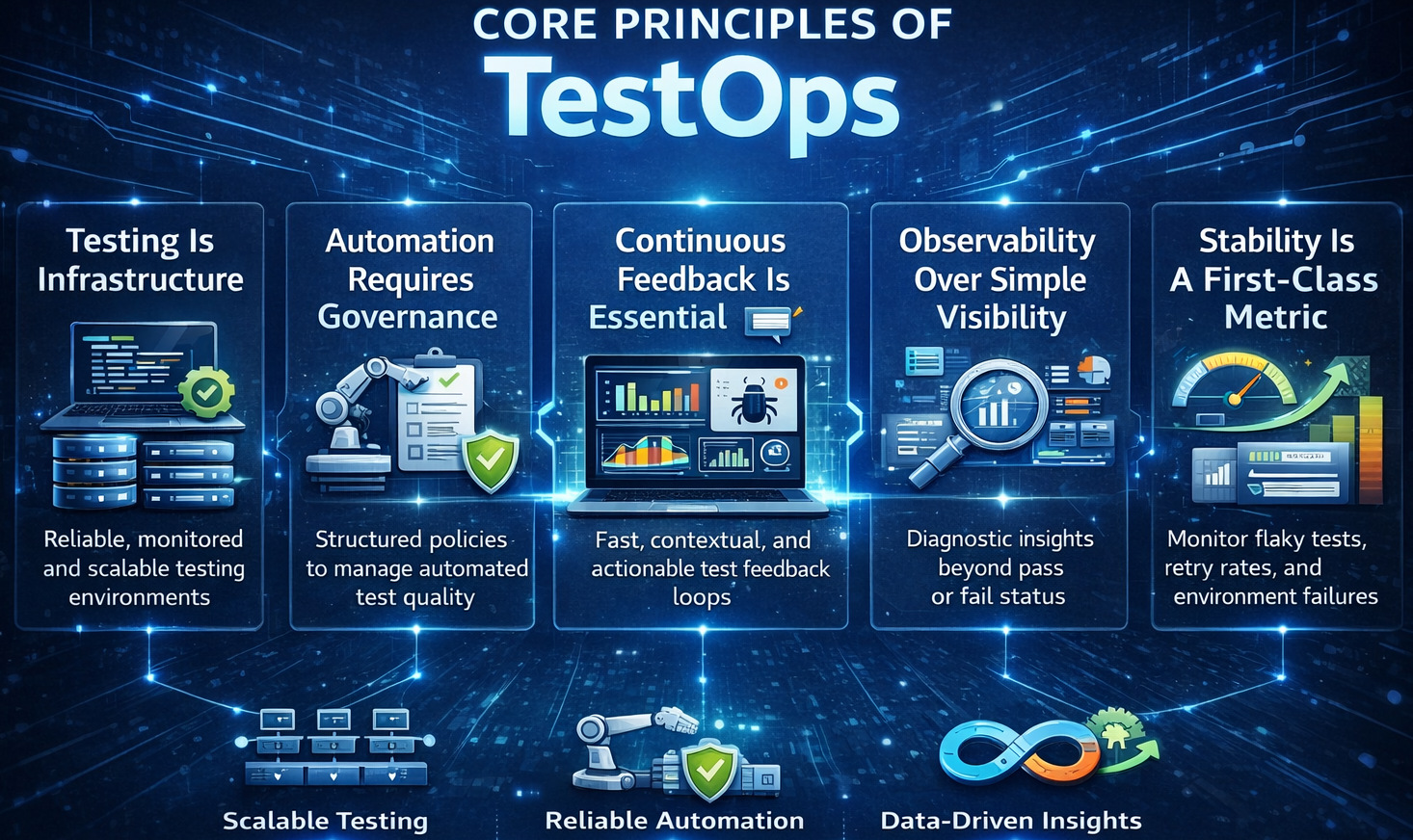
- Testing Is Infrastructure: You don ‘t want testing environments, pipelines, and automation frameworks simply to be stand-by utilities. They need version control, monitoring, observability, maintenance, and scalability, as instability at this layer directly undermines quality and release confidence.
- Automation Requires Governance: Increasing the number of automated tests doesn ‘t guarantee better quality. TestOps enforces governance with naming standards, ownership clarity, tagging strategies, de-duplication policies, structured code reviews, and the systematic retirement of obsolete tests.
- Continuous Feedback Is Essential: Feedback needs to be fast, accurate, contextual, and actionable in order to facilitate rapid delivery cycles. TestOps integrates testing outputs into CI dashboards, chat systems, quality gates, and defect tracking tools to deliver immediate and meaningful insight.
- Observability Over Simple Visibility: Visibility indicates if the test was successful or failed, while observability explains why. TestOps improves diagnosis by utilizing logs, traces, screenshots, metric correlation, and analysis of historical failure patterns to reduce investigation time.
- Stability Is a First-Class Metric: Contemporary companies are monitoring the number of deployments and the failure rate, but stability in testing really needs to be taken into consideration. TestOps introduces metrics such as flaky test rate, retry rate, environment failure rate, mean time to stabilize, and overall pipeline reliability index to ensure that we trust automation.
TestOps vs. Traditional QA
Traditional QA concentrates on designing and executing test cases to validate application functionality. TestOps, in contrast, focuses on operating, stabilizing, and optimizing the entire testing ecosystem to ensure scalable and reliable quality delivery.
| TestOps | Traditional QA |
|---|---|
| Operates and manages the entire testing system as infrastructure. | Focuses primarily on writing and executing test cases. |
| Uses automated, orchestrated, and scalable environments. | Relies on manually configured or semi-managed environments. |
| Implements structured test data management with versioning and control. | Often uses static or manually prepared test data. |
| Builds observability systems and quality intelligence dashboards. | Measures quality mainly through pass and fail counts. |
| Tracks stability metrics such as flaky rate and pipeline reliability. | Primarily tracks defect counts and test execution results. |
| Strengthens and scales QA through operational discipline. | Functions mainly as a validation phase within development. |
The Pillars of TestOps
TestOps is structured around foundational pillars that ensure testing operates as a reliable, scalable, and intelligent system. These pillars collectively transform automation from isolated scripts into a governed, observable, and continuously optimized ecosystem.
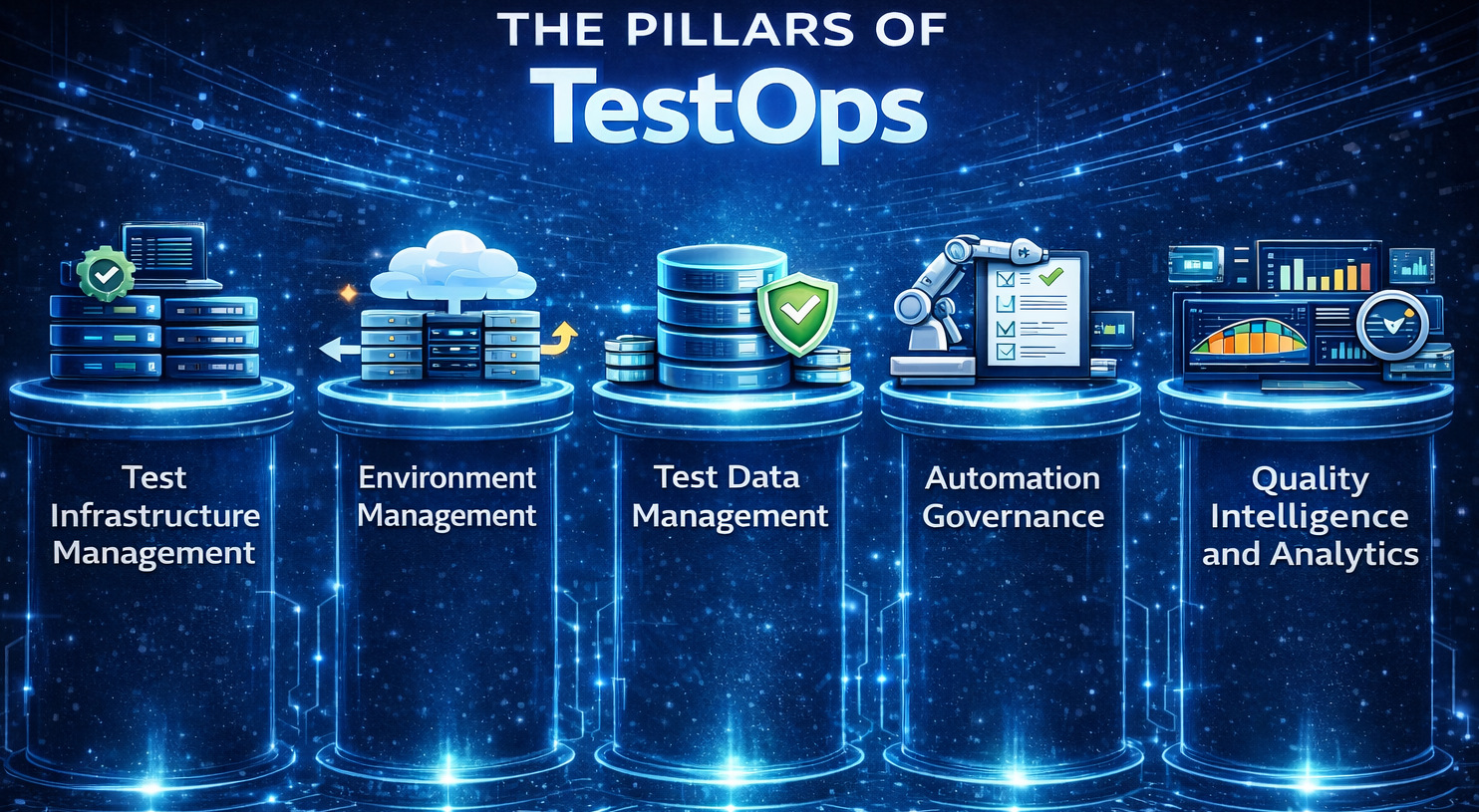
- Test Infrastructure Management: This line of management can support everything from CI and CD integration, execution orchestration, containerized environments, parallel frameworks, and cloud-based test grids. The main aim is to have reliable, repeatable, and scalable test execution on delivery pipelines.
- Environment Management: TestOps enforces Infrastructure as Code provisioning, environment version tracking, and dependency control while maintaining consistency. It also supports automated teardown, reset, and continuous environment health monitoring to avoid instability.
- Test Data Management: Data instability is a major cause of unreliable automation, making structured data management essential. TestOps supports synthetic data generation, masked production datasets, data versioning, on-demand provisioning, and automated cleanup to maintain consistency and compliance.
- Automation Governance: Automation governance ensures that test suites remain maintainable, stable, and aligned with evolving systems. This includes clear ownership models, lifecycle management policies, and ongoing stability tracking to prevent automation decay.
- Quality Intelligence and Analytics: TestOps builds advanced dashboards that highlight failure trends, regression hot spots, risk scores, feature-level stability, and release readiness indicators. These insights transform raw test results into actionable intelligence for informed engineering and business decisions.
How to Implement TestOps
TestOps is not just about bringing on new tools or automation coverage. This includes developing operational discipline on testing infrastructure, data, governance, and continuous feedback. With a structured methodology, organizations can turn testing into a scalable, reliable system that supports fast and confident software delivery.
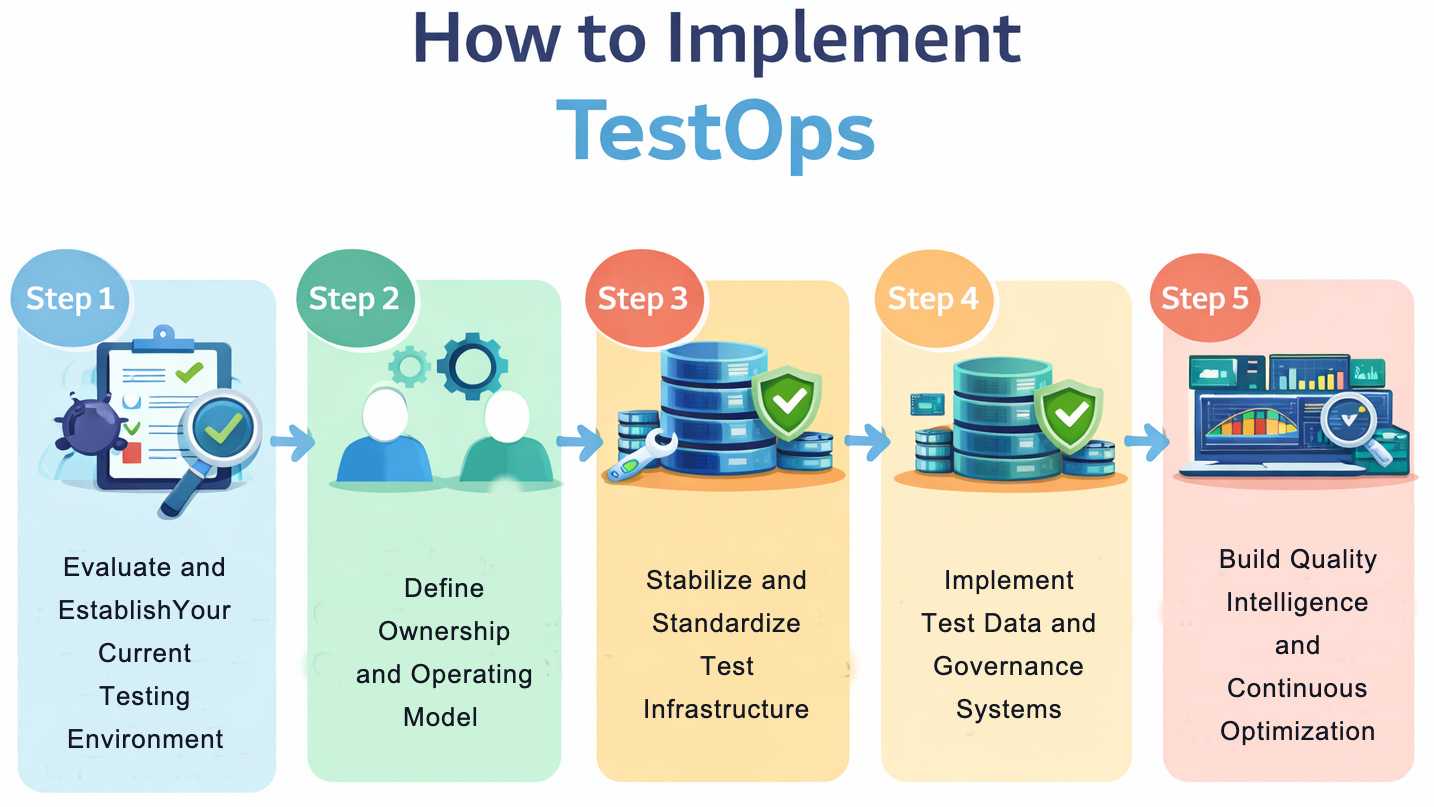
Step 1: Evaluate and Establish Your Current Testing Environment
Before implementing TestOps, you need to have a clear insight into where your testing is today. Most of the industry presumes the maturity of automation by failing to ascertain its stability, performance, and reliability.
Begin with an analysis of automation health, pipeline duration, flaky test rate, and environment reliability. Determine how frequently builds fail due to actual mistakes versus infrastructure or data problems.
Record the results of these experiments as quantifiable baselines. These benchmarks will allow you to measure and track improvements and rationalize the TestOps investments over time.
Step 2: Define Ownership and Operating Model
TestOps requires clear ownership across teams. Without defined responsibilities, improvements become fragmented and inconsistent. Decide whether you will create a dedicated TestOps team or adopt an embedded champion model within squads. Ensure someone explicitly owns test infrastructure, pipeline health, automation governance, and environment stability.
Clarify collaboration between QA, DevOps, platform engineering, and development teams. Shared accountability ensures that quality operations do not become siloed.
Step 3: Stabilize and Standardize Test Infrastructure
Stability must come before optimization. If automation is unreliable, scaling it will only multiply instability. Improve CI/CD pipelines by enabling parallel execution and separating fast feedback tests from full regression suites. Automate environment provisioning using Infrastructure as Code to ensure consistency and repeatability.
Implement flaky test detection and enforce accountability for fixing unstable tests. Capture logs, metadata, and artifacts to make failures reproducible and diagnosable.
Step 4: Implement Test Data and Governance Systems
Uncontrolled test data is likely to produce unstable results. TestOps also provides a way for structured data supply and cleanup mechanisms. Generate fake data or properly masked production data for testing safely.
Automate database resets and version your seed data to avoid infecting one test run after another. Adopt guidelines and governance for automation naming, tagging, and ownership. Formulate rules to keep flaky and obsolete tests from lingering in high-stakes pipelines.
Step 5: Build Quality Intelligence and Continuous Optimization
Once the infrastructure is in place, concentrate on visibility and intelligence. Pass or fail results alone are too simplistic for strategic decisions. Create dashboards that monitor flaky rates, trends in pipeline duration, defect escape, and feature-level stability.
Give leadership a picture of the release readiness based on measurable risk signals. Regularly review these metrics and then leverage patterns to retool. The only way TestOps can be sustainable is when it is in the form of a continual improvement system, and not as a one-off activity.
TestOps Maturity Model
- Level 1: Basic automation, along with CI integration, in which automated test execution is enabled during builds, yet with limited oversight.
- Level 2: Automated pipelines support parallel test execution, improving speed and feedback cycles while increasing pipeline efficiency.
- Level 3: Centralized management of test infrastructure and test data systems, which provides stable environments, controlled data provisioning, and also allows scalable execution.
- Level 4: Advanced analytics, trend monitoring, and stability metrics enable risk-based release gating across the quality intelligence platforms.
- Level 5: Quality systems that have intelligent optimization, predictive insights, and self-healing methods. They enable the maintenance, monitoring, and measurement of test quality that results in continuous improvement in the test efficiency and reliability.
Benefits and Limitations of TestOps
TestOps brings structure, scalability, and reliability to modern software testing operations. However, like any operational transformation, it also introduces challenges that organizations must manage carefully.
| Benefits | Limitations |
|---|---|
| Improves test stability and reduces flaky failures. | Requires cultural change across teams. |
| Accelerates CI/CD pipelines through optimized execution. | Initial setup can be time-consuming. |
| Enhances release confidence with data-driven quality insights. | Demands skilled resources with cross-functional expertise. |
| Increases automation reliability and trust. | Tool integration complexity can slow adoption. |
| Enables scalable environment provisioning through automation. | Infrastructure costs may increase initially. |
| Provides real-time quality dashboards for leadership decisions. | Metrics overload can create confusion if not structured. |
| Reduces manual intervention in regression cycles. | Governance processes may feel restrictive to teams. |
| Improves collaboration between QA, DevOps, and development. | Legacy systems may require significant refactoring. |
| Enables faster defect detection and root cause analysis. | Flaky test cleanup may require substantial effort upfront. |
| Supports continuous improvement through measurable metrics. | ROI may not be immediately visible in the early stages. |
Conclusion
TestOps is a shift in the perspective of how companies approach quality. That is evolving from a reactionary validation exercise to a disciplined, scalable, and operational function within the software lifecycle. And TestOps makes quality keep up with today’s delivery speed and architectural complexity, using infrastructure reliability, automation governance, environment orchestration, and data-driven intelligence. As software is developed and updated at an increasingly rapid pace, companies that view testing as an operational platform rather than a base-level service will be empowered to ship fast, smoothly, and confidently on scale.
FAQs
Does TestOps require replacing our current testing tools?
Not necessarily. TestOps is tool-agnostic. It is about how you wrap those tools in a scalable architecture. The transition to TestOps usually involves adding orchestration layers (like Kubernetes or Docker), centralized reporting (like Allure or specialized dashboards), and automated data provisioning tools rather than throwing away your existing test suites.
Why is “Testing as Infrastructure” a core principle here?
In a modern pipeline, you cannot rely on “static” test servers that stay on 24/7. “Testing as Infrastructure” means using Infrastructure as Code (IaC) to spin up an exact replica of the production environment for every single pull request. Once the tests are finished, that environment is destroyed. This eliminates environment drift, where tests fail simply because a server’s configuration was manually changed six months ago and forgotten.
Is TestOps just a fancy name for Automated Testing?
No. Automated testing is the act of writing scripts to verify software features. TestOps is the operational framework that manages those scripts. While Automation focuses on the test code, TestOps focuses on the infrastructure: how tests are triggered, where the data comes from, how the environments are provisioned, and how results are analyzed across the entire organization.