
This is the era of rapid software delivery, and organizations are always under pressure to deliver faster, while maintaining or even improving quality. In this context, DevTestOps is increasingly gaining relevance as a means to combine development (Dev), testing (Test), and operations (Ops) into a single pipeline.
At its core, DevTestOps aims to integrate quality and testing practices throughout the software delivery lifecycle, rather than treating testing as a late-phase activity. DevTestOps is a methodology that integrates continuous testing into the DevOps pipeline, breaking the barriers between development, testing, and operations.
It emphasizes a collaborative, “shift-left” approach to quality, striving to achieve faster releases and higher reliability by testing early, often, and continuously throughout the software development lifecycle (SDLC).
So what exactly is DevTestOps? Why is it emerging now? How does it differ from traditional DevOps or TestOps? Read this article to find answers to all these questions.
DevTestOps – Definition, Concept, and Meaning
Let us first understand how DevTestOps originated. For this, you need to first understand DevOps and TestOps.
What are DevOps and TestOps?
- DevOps is the set of practices, culture, and tools that integrate software development (Dev) and IT operations (Ops) to shorten the lifecycle of system changes, increase deployment frequency, and deliver with high reliability. DevOps emphasizes automation (CI/CD), collaboration between teams, and feedback loops.
- TestOps is a less-familiar term, but one that highlights the optimization of test practice: test automation, test infrastructure, continuous testing, and feedback loops focused on quality rather than just delivery speed.
DevOps and TestOps are both important parts of the SDLC. Instead of having development, testing, and operations teams work in separate environments, some organizations are beginning to consolidate all three teams into an integrated process called DevTestOps.
DevOps enabled collaboration across developers and operators. Then, testers carried out testing towards the end of the development. However, this arrangement posed some challenges to the team. For example, after working on the software development and concluding it was ready for production, testers run their tests and discover complex issues.
This has given rise to DevTestOps.
What Does DevTestOps Mean?
DevTestOps is a methodology (or operating model) in which development, testing, and operations teams work in a coordinated, integrated manner throughout the software delivery lifecycle, with continuous testing (early, often, and automated) embedded in the CI/CD pipeline so that quality is not an afterthought but built in.
In simpler terms, instead of developers writing code, handing it over to testers, and then handing it over to operations, DevTestOps ensures a seamless flow: Code Commit followed by automated tests, deployment, operations feedback, and code changes. All these steps are performed continuously and collaboratively.
In DevTestOps, you test the product throughout the different SDLC stages. The Development, Testing, and Operations Teams work hand in hand to ensure quality and proper product testing.
- In DevTestOps, testing is no longer a distinct, late phase but woven into the pipeline (“shift-left” and even “shift-right”).
- Development, testing, and operations teams collaborate as one cross-functional team rather than isolated groups.
- Automation, feedback loops, and continuous quality are central to the process.
- The goal is faster time-to-market and higher quality, but not at the expense of the other.
- DevTestOps can be viewed as an improved version of DevOps with TestOps included, which makes it easier to build, deploy, and develop quality products with fewer bugs.
Why the Name “DevTestOps”?
The term DevTestOps arises because many organizations adopting DevOps found that while Dev and Ops teams were being integrated, testing remained isolated. Hence, testing was also combined with DevOps, and this gave rise to DevTestOps.
Thus, “Dev+Test+Ops” explicitly acknowledges the testing function as a first-class citizen in the pipeline.
Why is DevTestOps Needed?
To understand the need for DevTestOps, let us first understand the scenario that prompted the need for DevTestOps.
Challenges in traditional models
- Testing is not performed until near the end of the development cycle. This results in defects being identified towards the end. At this point, they are expensive to fix, and the release is delayed.
- Development, testing, and operations teams often work independently, leading to communication friction, delayed feedback, and handover overhead.
- There is always pressure to release faster, which makes organizations cut down on testing. This, in turn, increases the risk of failures in production, negative user experience, rework, and cost.
- Independent, separate testing often means slower feedback loops; testers may only find bugs after the application is deployed. This increases the cost of correction and reduces agility.
The DevTestOps Objectives
- Faster Time-to-Market: Since testing is continuous and embedded in the pipeline, changes can be verified and deployed more rapidly.
- Higher Quality: Testing is conducted frequently and early in the SDLC, which means defects are found earlier when they are cheaper to fix; also, operations feedback improves reliability.
- Lower Cost / Lower Risk: With continuous and embedded testing, there are fewer late-stage surprises, fewer production failures, and a lower need for firefighting.
- Better Collaboration and Visibility: Development, QA, and operations teams share responsibility for quality, and visibility into pipelines is improved with no barriers.
- Continuous Feedback and Improvement: DevTestOps not only improves deployment speed, but metrics and learning from production feedback also feed into earlier stages.
DevTestOps thus enables organizations to deliver software faster, with better quality, in a collaborative, automated manner.
Key components of DevTestOps
Implementing DevTestOps involves several dimensions. Below are the major components of DevTestOps:
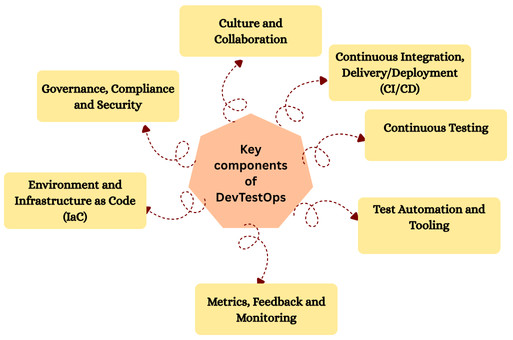
1. Culture and Collaboration
DevTestOps encourages a cross-functional collaborative culture between developers, testers/QA, and operations teams. Quality is everyone’s responsibility. The teams involved share goals and KPIs instead of operating in isolation.
In DevTestOps, teams break away from the traditional notion of “Dev builds it, QA tests it, Ops deploys it” to a unified workflow.
2. Continuous Integration, Delivery/Deployment (CI/CD)
A robust pipeline in DevTestOps has every commit triggering build, automated test suites, and deployment into test/staging/production environments.
Automation is the key here with build, deployment, and environment provisioning, such as Infrastructure as Code, containers, and cloud automation.
The software is released as frequent small changes instead of a large monolithic release.
3. Continuous Testing
This component of DevTestOps includes automated unit tests, integration tests, regression tests, UI tests, performance/load tests, and security tests. Testing is performed earlier in development (shift-left testing) rather than kicking it off after the development is complete.
Production environment is continuously tested and monitored (shift-right testing), incorporating real-user and operational feedback. There are automated checks like test coverage, performance thresholds, and security vulnerabilities that the application should pass before progressing through the pipeline.
4. Test Automation and Tooling
DevTestOps makes extensive use of test frameworks, automated scripts, and headless browsers. Test environments that mirror production are easily added or deleted dynamically. Tools for test data management, service virtualization (for dependencies), and monitoring are employed for performance and reliability.
These tools are integrated with CI/CD pipelines, so tests run automatically and results are fed back.
5. Metrics, Feedback, and Monitoring
This component involves the use of metrics, real-time feedback, and monitoring in production to ensure the software functions as expected.
Key metrics like deployment frequency, change lead time, defect escape rate, mean time to recover, test pass/fail rates, code coverage, and production outages are tracked. (Note: many of these come from DevOps research, such as the DORA metrics.)
A mechanism to direct real-time feedback to dev/test teams in case of test failure or deployment issue in production is put in place.
Operational metrics, user behaviors, and error dashboards continuously provide feedback to development and testing teams for improvement.
6. Environment and Infrastructure as Code
DevTestOps provisions reproducible test environments, including dev, test, staging, and production, using infrastructure as Code (IaC), containers, and orchestration tools. This ensures that the test environment is similar to production, which reduces deployment surprises.
These test environments can be added or removed automatically so that the CI/CD pipeline is not delayed. However, a challenge that DevTestOps might face is to create production-like environments that are reliable and cheaper.
7. Governance, Compliance and Security (as appropriate)
These parameters are not always emphasized in DevTestOps, as they are mostly part of DevSecOps. Still, many organizations integrate security and compliance checks, such as static code analysis, vulnerability scanning, and configuration hardening into the DevTestOps pipeline.
Since operational resilience and security of the system depend on quality and reliability, test planning must include non-functional tests such as performance, security, usability, and reliability.
DevTestOps Methodology: A Step-by-Step Implementation
DevTestOps is implemented using a structured approach. Below is the general step-by-step approach that implements DevTestOps, though some aspects may differ with every organization.
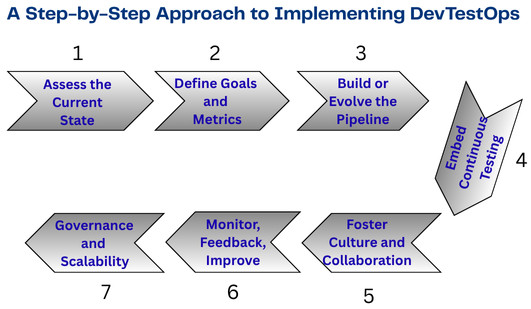
Step 1: Assess the Current State
Assessing the current state begins with identifying hand-offs, bottlenecks, test coverage gaps, environment mismatches, and deployment delays. Each team structure is evaluated to determine its collaboration level.
Metrics include lead time for changes, defect escape rate, and frequency of deployments. Toolchain maturity is identified in this step for CI/CD pipelines, automated testing, environment provisioning, and monitoring.
Step 2: Define Goals and Metrics
This step involves setting clear objectives and defining metrics to track progress. Specific objectives like reducing lead time from commit to deploy by x%, reducing production defects by y%, or increasing test automation coverage by z% should be defined so that the team has a clear idea about working towards a specific goal.
Metrics such as deployment frequency, mean time to recover, test pass rates, and change failure rates are defined in these steps.
It also involves getting a buy-in from stakeholders such as product owners, QA, dev, and operations around shared goals and responsibilities.
Step 3: Build or Evolve the Pipeline
In this step, the CI/CD pipeline is newly established or an existing one is improved so that every code commit triggers automated builds and tests. Unit, integration, and regression tests are executed automatically after a commit. Environment provisioning using containers, IaC, and cloud resources is used so that test and staging environments are spun up on demand.
Quality gates for criteria like test coverage thresholds, no critical defects, and performance thresholds are introduced so that these criteria are passed before deployment proceeds.
Step 4: Embed Continuous Testing
Continuous testing is embedded in the DevTestOps pipeline by expanding test automation suites to cover business-critical flaws, integration points, performance, and security tests.
Shift-left testing is included to ensure developers write tests early for unit and integration testing. With shift-left testing, testers work in parallel with the dev team rather than waiting for development to conclude.
Shift right testing is also part of this step, which includes production monitoring and post-deployment validation, such as synthetic tests, smoke tests, and user-behavior monitoring.
In addition, test data management and service virtualization to decouple dependencies are used to enable faster, reliable tests.
Step 5: Foster Culture and Collaboration
To encourage culture and collaboration, cross-functional teams consisting of Dev, QA, and Ops are created so that they share the ownership of quality. Transparency is promoted using dashboards, visibility of pipeline status, test results, and production metrics.
A small pilot project with one product or team is started to gather learnings. If this is successful, it is scaled. Continuous learning through retrospectives, post-mortems, and root-cause analysis for failed deployments or production issues is encouraged in this step.
Step 6: Monitor, Feedback, Improve
This is a tracking step where metrics for deployment frequencies, number of defects, or lead-time are continuously tracked. Test failures are reviewed to find and analyze the root cause, and update tests or the pipeline accordingly.
As the pipeline matures, test types are expanded to include more types, test suites are optimized, and bottlenecks are eliminated, which aids in continuous improvement. Once a product or team matures, these practices are replicated across the organization, pipelines are standardized, and components are shared.
Step 7: Governance and Scalability
Standards for pipelines, test automation, environment configuration, and monitoring are established, and pipelines across products and teams are scaled by building reusable templates and platforms for CI/CD and testing.
Ensure test environments mirror production as much as possible to avoid post-deployment surprises. Non-functional testing, including performance, reliability, and security, should be planned. These require specialized tooling and longer execution times.
Benefits of DevTestOps
- Accelerated Delivery: With embedded and automated testing, organizations can shift from long release cycles to frequent and continuous releases. With this accelerated delivery, market responsiveness is improved.
- Improved Quality and Reliability: Due to continuous and early testing, defects are caught earlier, code is validated continuously through testing and monitoring, reducing production failures, downtime, and customer-facing defects.
- Lower Cost, Less Rework: Late-stage defects are expensive to fix. DevTestOps reduces these downstream costs as embedded testing catches defects early on that are fixed at a lower cost.
- Better Collaboration and Less Friction: Dev, QA, and Ops teams working together reduce hand-overs, miscommunications, and delays. Shared responsibility encourages a culture of quality and ownership.
- More Predictable and Stable Deployments: Automation, quality gates, and continuous feedback create more reliable pipelines, fewer deployment surprises, and less “it worked in dev but fails in production”.
- Enhanced Scalability and Reuse: Once pipelines, test automation suites, and environments are established, they can be reused across teams and products, improving efficiency.
Challenges in DevTestOps
- Organizational and Cultural Resistance: Teams like dev, testing, and ops that often work in isolation may resist cross-functional collaboration. Testing/QA teams may feel threatened, and developers may resist writing or maintaining tests. Changing deployment models and automation responsibilities may pose a challenge for the Ops team.
- Test Environment and Data Issues: Building test environments to mirror production with the same scale, configuration, and data is costly and complex. Managing test data, dependencies, and virtual services can be complex, too.
- Test Automation Maintenance Burden: Automated tests need ongoing maintenance and are a burden. Flaky tests reduce confidence and create noise. Tests must be meaningful, as high test coverage does not necessarily mean high quality.
- Choosing the Right Test Types and Timing: Determining tests to be automated, executed, and environments to be used, and prioritizing tests can be tricky. Performance and security tests often are long-running and harder to automate in fast-moving pipelines.
- Toolchain Complexity and Integration: It is technically demanding to integrate CI/CD, automated tests, environment provisioning, monitoring, and analytics. Pipelines can become brittle without proper tooling.
- ROI and Measurement: Measuring ROI of testing measurements, such as how many defects are avoided, how much cost is saved, can be difficult without mature metrics.
- Balancing Speed vs Quality: There is a risk of speed outpacing test automation and coverage, in the case of DevTestOps, leading to quality issues.
Best Practices for Successful DevTestOps
- Start Small and Scale: Pilot with one team/product, refine the approach, then expand.
- Embed Test Automation Early: Ensure unit/integration tests are part of the commit/build process; automate where feasible.
- Ensure Test Environments Mirror Production: Use containers, cloud, and IaC to provision realistic environments quickly.
- Make Test Results Visible: Show dashboards of pipeline status, test pass/fail, coverage, and production metrics.
- Define Quality Gates: For example, “build cannot progress unless unit coverage is above X% and no critical defects exist”.
- Use Metrics and Monitoring: Track deployment frequency, lead time, defect escape rate, mean time to recovery, and other key performance indicators.
- Automate Everything You Can: From builds, tests, deployments, to environment provisioning and rollback.
- Maintain Test Suites: Remove flaky tests, ensure tests are meaningful and aligned with business value.
- Collaborate and Share Ownership: QA/testers, developers, and operations staff should collaborate in planning, design, execution, and monitoring.
- Continually Improve: Use retrospectives, post-mortems, root-cause analysis, and refine pipelines and practices.
- Include Non-functional Testing: Ensure performance, scalability, reliability, and security tests are built into the pipeline (though these may run less frequently or in dedicated environments).
- Governance and Platform Reuse: Establish a “development platform” or internal service that provides shared CI/CD/test pipelines to reduce duplication and improve consistency.
DevTestOps in the Real World
Here are a few real-world scenarios of how DevTestOps might play out in practice.
Scenario 1: E-commerce Feature Rollout
- Developers commit code to the feature branch; unit tests are executed immediately.
- On merge to the main branch, CI triggers integration tests (checkout flow, payment gateway simulation), and automated performance tests (load simulated 1000 concurrent users).
- The code is deployed to a staging environment via IaC (containerized). End-to-end regression tests are run, including UI tests.
- Once quality gates are passed (unit/integration/regression/performance), automated deployment to production occurs. Post-deployment monitoring alerts if checkout success rate drops or latency rises.
- QA, Dev, and Ops review results together in daily stand-ups; any anomaly triggers roll-back or hot-fix. The entire pipeline is reproducible and transparent.
Scenario 2: SaaS Application with Frequent Updates
- Every commit triggers automated test suites (unit + integration + API + UI + security scans).
- Feature toggles are used so new features can be rolled out to small user groups; monitoring real-user behavior supports shift-right testing.
- If a production metric (e.g., error rate) crosses a threshold, rollback automation triggers, and the same test results are fed into retrospective to improve coverage for the missed scenario.
- Test environments are provisioned on demand in the cloud, using IaC, enabling parallel test runs and faster feedback.
Future Trends in DevTestOps
- AI/ML in Testing and Pipelines: AI/ML fields are being increasingly explored to optimize test suites. For example, for auto-generating tests, self-healing tests, and predictive analytics to identify high-risk areas of code.
- Shift-right and Real-user Feedback: As production environments become more dynamic with cloud, microservices, and serverless technologies, DevTestOps will extend further into production monitoring, chaos engineering, A/B testing, real-user behavior analysis, and proactive quality monitoring. The boundary between test/staging and production will become increasingly blurred.
- Platform-engineering and Internal Developer Platforms: Organizations will build “internal platforms” with replicable pipelines, environment provisioning, and test-automation frameworks to scale DevTestOps across many teams.
- Security, Compliance, and Non-functional Dimensions: While DevTestOps emphasizes testing and quality, the future will bind more tightly with security, reliability, performance, and resilience (think DevTestSecOps). Non-functional testing (load, chaos, security) will become more integral and automated in pipelines.
- Value Stream Thinking: More organizations will adopt value-stream metrics (end-to-end flow from idea to customer value) rather than just tech metrics. DevTestOps will need to align with business outcomes (customer satisfaction, revenue impact), not just pipeline speed/quality.
Summary
DevTestOps is an evolution of DevOps that brings testing and quality into the forefront of the delivery pipeline. It emphasizes continuous testing, cross-functional collaboration (development, testing, operations teams), automation of builds/deployments/tests, and feedback loops from production back into development.
By adopting DevTestOps, organizations can move faster, deliver with higher quality, reduce risk and cost, and align teams around shared responsibility for software delivery. However, implementing DevTestOps requires cultural change, investment in tooling, test automation maturity, environment provisioning, and ongoing metrics and feedback.
If you are an organization delivering software and want to improve both speed and quality, DevTestOps offers a compelling path. Beginning with a pilot, focusing on automation and test coverage, aligning teams, and tracking key metrics are concrete steps you can start to take.