Ever thought up something clever, yet wondered if it’d actually function in the real world? That moment is the perfect point to execute a Proof of Concept. It’s a trial run or version that lets you check if an idea works before spending more time on the project. This step shows whether something truly makes sense right at the start. The truth is, a POC cuts through the noise before you dive into months of work.
Here’s a look at what a proof of concept actually is. Why it plays a role worth noticing comes next. The way it functions shows up clearly once you see it in action. Instead of jumping to conclusions, comparing it to prototypes helps bring clarity. Even an MVP feels different when you study each step closely.
| Key Takeaways: |
|---|
|
Proof of Concept Definition
Finding out if an idea works often starts with something tiny. A test built just to see what happens. Sometimes it’s called a trial run, sometimes just a quick tryout. One way or another, it shows if the thought behind it holds up when put into practice.
Learning drives a POC, never scale. Instead of growth, it focuses on testing ideas. One goal matters – discovery. Expansion waits until later. Thus, proof comes before size.
It might be a tiny bit of code. Or maybe a sketchy version slapped together fast. It could even be trying something out with stuff you already have. The point is showing that the main thought holds up. Quite similar to dipping your toe in the edge of a pool, before diving in!
Why Proof of Concept Is Important
A lot of projects fail not because they’re bad ideas, but because they’re untested ideas. A test run shows what works here.
1. It Reduces Risk Early
Finding issues early means they’re caught before things get messy. Just that shift could wipe out weeks, sometimes even months of wasted effort.
2. It Saves Time and Money
Starting off on the wrong path can cost a lot. To prevent that, try your idea first through a small test version.
3. It Builds Confidence
A working example, however simple, makes progress feel real. People see it differently when they witness results. Momentum builds once others believe the idea holds up. Proof shifts how questions are asked around the table. Seeing function beats hearing promises every time.
4. It Brings Clarity
At the start, thoughts tend to be blurry. Turning one into a test version pushes clarity, however small it becomes.
Proof of Concept in Business and Startups
A POC run in companies usually checks if an idea, tool, or method works well before it gets wider use.
A startup faces tougher stakes. What matters most shifts faster here.
Starting small means mistakes won’t sink the whole effort. Founders test ideas quickly when time runs short, using a prototype to check if things work in real life. Instead of guessing what users might like, they see how people actually respond. This step happens long before spending most of the money. Failure at this stage costs less, both in cash and energy. Ideas get adjusted based on feedback, not opinions. Without it, teams risk building too much too soon.
Folks who fund projects get excited by proof of concepts too. These small POCs show you’re trying things out, not only talking about ideas.
Proof of Concept in Software Development
A POC in coding often shows if an idea works. Sometimes teams build a small version just to check the method. Testing comes before full production. A trial run can reveal hidden problems early. Proof of concept helps decide what happens next.
- Does the setup manage heavy loads of information?
- Do these two work together without issues?
- Could this fresh setup really handle what we need?
A POC in software doesn’t care about design or user experience. It only cares about one thing: does the tech work? Success means the system runs, nothing more. Hopes? They’re set aside. The screen can be blank; what counts is motion beneath.
Proof of Concept Process: How It Usually Works
A proof of concept does not come in just one form. However, here’s a generalized approach to going about it.
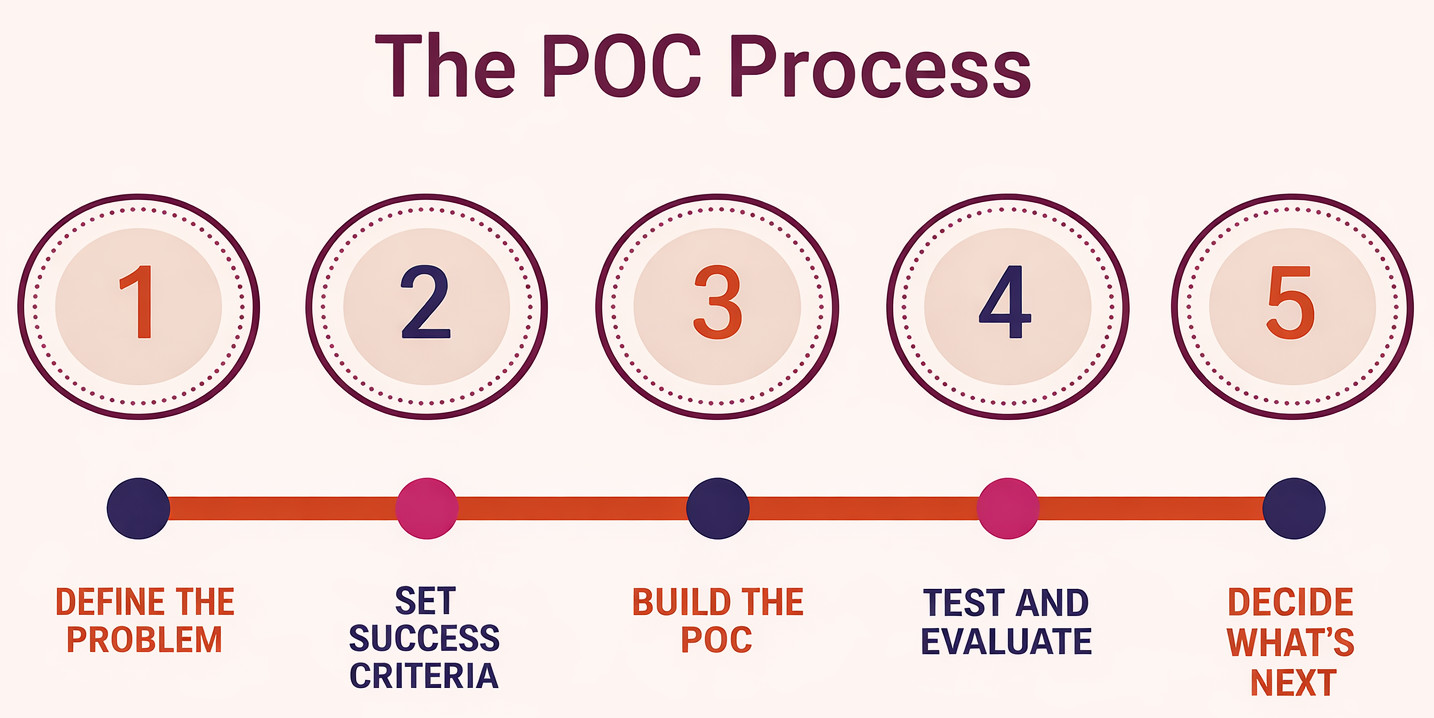
1. Define the Problem
A single guess matters most when you test something. Clarity comes first; know exactly what that is. Spreading too wide weakens results. Instead, pick the idea that could fail hardest.
2. Set Success Criteria
How do you know it’s working? Progress shows up in small steps, not big leaps. Results matter more than polish.
3. Build the POC
Faster beats perfect when things get rough. Grab what works, even if it’s old. Reuse tools. Skip polish. Speed matters more than beauty here.
4. Test and Evaluate
Start by testing your idea and observing the outcome. Notice where things fail, where they hold up, and sometimes what catches you off guard. Watch closely when glitches appear, moments that click, instances that feel unexpected. Read: Different Testing Methodologies: A Complete Guide for QA & Developers
5. Decide What’s Next
Success here means progress follows. When the test works, steps ahead open up.
Failing means a change is needed, maybe tweak it, maybe quit.
Whatever happens, there’s a lesson in it. One way or another, knowledge sticks.
Proof of Concept Example (Simple Scenario)
Imagine you want to build an app that uses AI to summarize long documents.
- Test if an AI model can summarize documents accurately
- Notice the time needed when handling big files
- See whether the outcomes really make a difference
This tiny experiment shows it can work.
Should it function properly, next comes shaping the layout and building it out.
When that fails, a new angle usually makes more sense.
Proof of Concept vs. Prototype vs. MVP
Confusion pops up often here. Time to sort it out.
Proof of Concept
- Answers: Can this work?
- Engineered specifically for checks within the team
- Focuses on feasibility
Prototype
- What does it seem like when you see it? How does it sit in your hands?
- Feedback on designs shows up here more than elsewhere
- Appears closer to something you’d actually hold in your hands
Minimum Viable Product (MVP)
- Answers: Will people use this?
- Released to real users
- Has just enough features to be useful
First up, a POC takes the lead. Then the prototype. Then the MVP.
Mistakes creep in when stages get missed. Every stage has its purpose.
When Should You Use a Proof of Concept?
- You’re working with new or untested technology
- You’re unsure if an idea is feasible
- You’re entering a new market
- You need stakeholder buy-in
- You want to reduce uncertainty before building
A heavy price tag, complicated details, or high stakes? That often means a POC makes sense.
What Comes After Proof of Concept?
After the test shows it holds up, step two begins. Crafting a version others can touch or try out.
The first version often shows up like this. It might be rough around the edges, but it works well enough to test ideas.
Here’s what really matters.
Decisions come from proof, never guesses. That’s the whole point of a POC: showing what works before moving forward.
Why Proof of Concept Matters
Steering clear of poor choices becomes easier when you’ve done a POC. That kind of guidance shows where trouble might hide. Picking what works feels less like guessing. A proof-of-concept (POC) cuts through noise when things move fast. It shows what works without extra talk.
Pause for a moment. Think it through first. What really matters here? Could there be another way? Maybe wait, just briefly, and consider what happens if things go sideways. Is that outcome worth the risk? Often, stepping away brings clarity. The rush fades. Then decide
“Have I proven this can work?”
If not, your next step is clear.