When finding your way through software testing, chances are you’ve run into a conversation about the testing pyramid. That concept tends to sit high on a pedestal among testers and developers alike. Yet after a while, a different phrase begins showing up more often, the inverted test pyramid. This throws off what once seemed like a solid strategy.
Could this be a fresh strategy?
Could be wrong. Maybe not.
Could this be worth welcoming instead of shying away from?
Think of this strategy as a quiet shift in how teams verify their code. The testing pyramid gets flipped upside down, with most tests happening close to the implemented code rather than at the UI level. It fights bloat by valuing speed and precision. When too many tests pile up at the surface, things get fragile. That messy weight is what people mean by “Ice Cream Cone” – top-heavy, melting under pressure!
A better balance means catching problems earlier, without drama.
| Key Takeaways: |
|---|
|
Understanding the Traditional Testing Pyramid
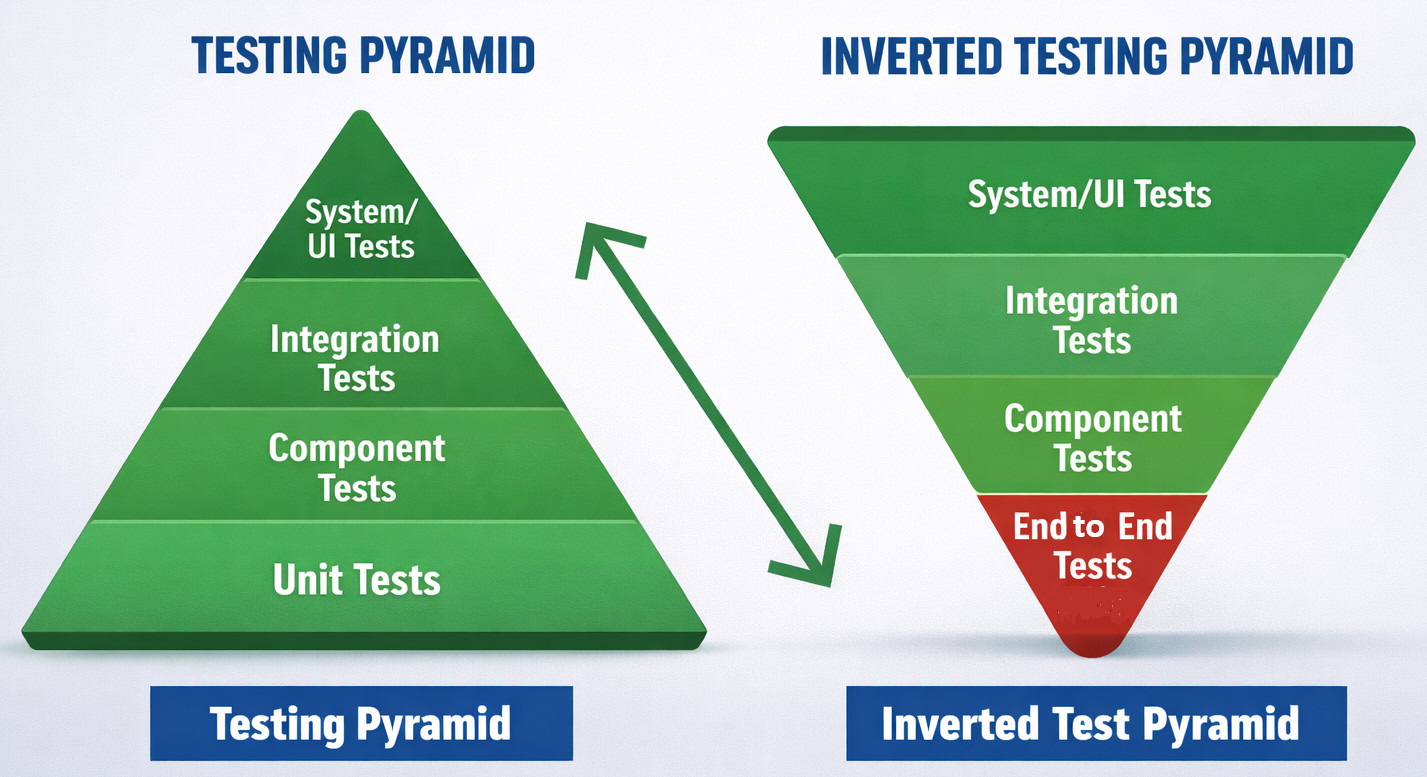
- Bottom layer packed with unit tests. These are quick, low-cost, and give solid proof that they work.
- Midway through, a few API checks make sure pieces fit right – using integrations or APIs to test teamwork between components.
- Finally, a few tests live up there, i.e., UI or end-to-end tests – they take time, cost more, and yet, they matter.
It’s shaped like a pyramid because that structure keeps test suites stable, fast, and easier to maintain. Mistakes show up right away if you start close to the code. Feedback reaches developers before they move on.
But more often than not, when the pyramid is put to the test in the real world, something else happens. The drift leads to the inverted pyramid slipping through.
What Is the Inverted Test Pyramid?
- Lots of UI or end-to-end tests at the top.
- Some integration tests in the middle layer.
- Very few unit tests at the bottom.
Something like this tends to show up without planning. Rarely does a QA team choose to suddenly flip its structure upside down. Over time, it slips in, almost unnoticed, sometimes starting with solid reasons like wanting confidence in user flows.
Writing unit tests takes effort, yet it builds clarity over time. It usually happens when a team shifts right but forgets to shift left. They focus so much on testing the final product (UI) that they ignore the quality of the building blocks (unit). This often happens in teams where “Developers don’t test” and “QA does everything at the end”.
Before you even notice, the pyramid stands on its tip.
How To Identify An Inverted Test Pyramid?
- Excessive Volume of UI Tests: A big component of the test suite lives at the UI level, while lower-level tests are sparse or missing.
- Slow Test Execution: Test executions take a long time, making feedback cycles painfully slow and discouraging frequent testing.
- Weak or Missing Unit Tests: Core business logic isn’t well covered, so small code changes feel risky.
- Frequent Flaky Tests: Tests fail randomly due to timing issues, environment instability, or minor UI changes.
- High Maintenance Effort: Teams spend more time fixing broken tests than writing new ones or improving product features.
- Delayed Releases: Builds are often impacted by failing UI tests, slowing down deployments.
- Issues Seeping into Production: Bugs slip past because UI tests pass while the underlying logic remains untested.
The Ice Cream Cone Anti-Pattern – What is It?
The ice cream cone anti-pattern is a cautionary tale. It’s what happens when a team’s testing strategy is driven by “afterthoughts” rather than a solid plan. It is considered an anti-pattern, meaning it is a common way of working that usually leads to high costs and slow releases.
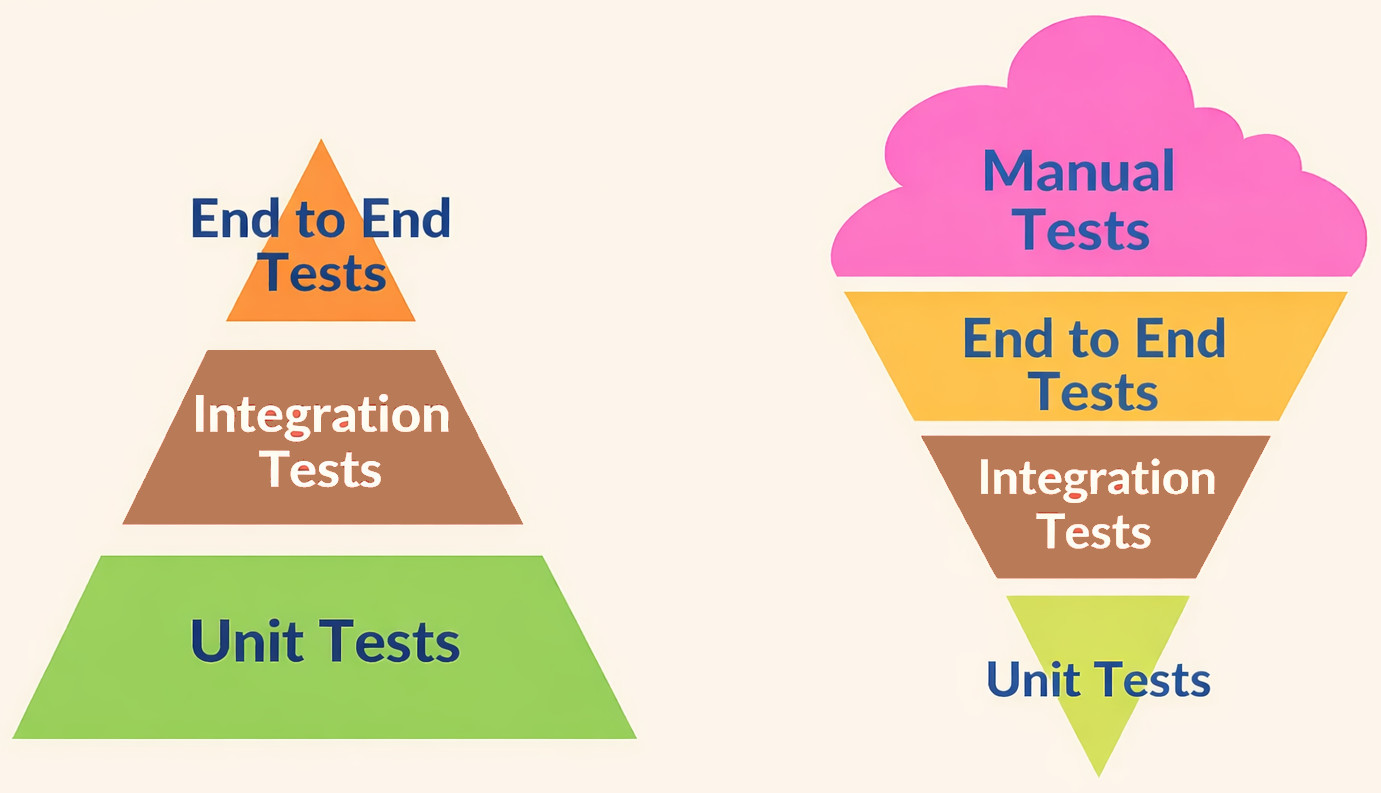
- Manual and exploratory tests form the top part, the heavy ice cream. It looks quite impressive due to the bulk, so many testers peering through the application. Yet, it isn’t as beneficial as one might expect.
- Coming to the cone, which is an inverted pyramid. You have end-to-end tests below the ice cream section.
- Then comes a very small number of integration tests.
- Finally, a tiny number of unit tests for the tip or the bottom of the cone.
Problems With the Ice Cream Cone Anti-Pattern
- The Heavy Manual Testing Topping: When you expect humans to do repetitive tasks that require high accuracy, like regression tests after every deployment, you’re bound to run into problems. While manual testing is great for creative testing, it can pose a bottleneck and lead to unreliable test results for repetitive tasks.
- Brittle Automated UI Tests: While there are automated tests, the majority are UI or end-to-end tests. These are again resource-intensive and slow, thus taking too long to offer feedback. Quite often, these tests tend to be brittle too, as even small UI changes like the change in a button’s color can cause a test to fail. All this ultimately means for test maintenance.
- Neglected Unit Tests: These are the lightest of the tests and are most neglected. It could be because developers decide to leave all the testing to testers, hence the focus on UI and manual testing. Unit tests are the fastest and most inexpensive way for developers to gain quick feedback on their code. Without unit tests leading the testing, the entire process is bound to be messy.
Testing Pyramid vs Inverted: What Really Changes?
| Feature | The Healthy Pyramid | The Inverted “Ice Cream Cone” |
|---|---|---|
| The “Vibe” | Proactive. You catch mistakes while you are still typing the code. | Reactive. You find mistakes days or weeks later and have to firefight. |
| Speed of Feedback | Instant. | Delayed. |
| Cost to Fix | Cheap. Fixing a typo in the blueprint phase costs almost nothing. | Expensive. |
| Who is Testing? | Everyone. Developers check their own work; Testers focus on “big picture” logic. | The “QA” Silo. Developers just “throw code over the wall” for someone else to fix. |
| Reliability | Solid. Tests are simple and rarely break by accident. | Brittle. Tests break constantly because a button moved 2 pixels to the left. |
| User Experience | Smooth. New features come out fast, and they actually work. | Frustrating. Bug fixes are slow, and new updates often break old features. |
UI Heavy Testing: Why Teams Fall Into This Trap
- Seeing Many UI Tests is Reassuring: To most stakeholders, like product owners or managers, a unit test (a few lines of code checking a math equation) feels invisible and unimportant. On the contrary, a test that opens a browser window and does a few operations feels like a true test. But these tests are much slower, take longer to provide feedback, and are difficult to maintain compared to unit tests.
- Testing as an Afterthought: If developers and testers work in silos, this is bound to happen. Developers write the code and leave it to the testers to validate. By the time the testers get the software, it’s already a finished house. They can’t easily check inside (the code), so they are forced to test the UI over and over again.
- Legacy Code Disadvantage: Sometimes, a team inherits an old system that wasn’t built with testing in mind. The code is so tangled that writing a simple unit test is almost impossible. When you can’t test the individual parts, your only option is to test the whole thing at once from the outside. This forces the team to build a massive layer of UI tests because they are too afraid to touch the code underneath.
- Problematic Testing Tool Choice: With a variety of no-code/low-code tools available that make creating UI tests easy, teams tend to opt just for these. While these tools are great for building your UI tests, neglecting unit and integration level testing is a poor test strategy that will come back to bite in the long run.
Maintenance Costs in Testing: The Hidden Price of Inversion
When the test suite leans heavily on UI and end-to-end tests, like in an inverted testing pyramid, the hidden costs of maintenance start to escalate quickly. A small update? Often means tracing failures across fragile chains. Long after launch, effort piles up. Tests meant to help become hurdles. Each change risks new confusion. What worked yesterday stumbles today.
- Fragile Testing: UI-dependent tests break easily with even small UI tweaks. New labels, rearranged layout, and even different loading times can cause failures. These fragile scripts need frequent updates to stay green.
- Delayed Testing: High-level tests are, by design, slower to run than unit or API tests. The more you rely on them, the more your CI/CD cycles drag out, delaying feedback and slowing down development work.
- Impact on Workforce: Teams waste a lot of time waiting for slow test results, fixing brittle UI tests, or rewriting broken automation. This can seriously frustrate both developers and testers.
- Accumulating Test Debt: Over time, many automated tests become obsolete, redundant, or irrelevant. Without regular cleanup, this “test debt” delays regression cycles and increases overhead.
- Tooling and Environment Overhead: Maintaining the right tools, integrations, and stable test environments adds extra costs. This is not just in licenses, but also in effort and infrastructure maintenance.
- Flaky or Inconsistent Outcomes: Tests that pass and fail unpredictably (flaky tests) create additional work. Every failure has to be investigated regardless, even if nothing is actually broken in the code.
- Redundant Efforts: Without good test design, you may end up duplicating similar checks across many tests. Updating the same logic in multiple places adds unnecessary maintenance effort.
What once caught bugs now demands constant fixes. Each tweak adds friction instead of freedom. Time meant for progress gets lost in the maintenance burden. Momentum fades as delays pile up. Attention drifts from creation to cleanup.
Is the Inverted Test Pyramid Always Bad?
When You Can Get Away With It
- Legacy Codebases: When the codebase is hard to refactor or unit test, higher-level tests may be the only realistic option.
- Disposable Prototypes: While meant to be thrown away, they stick around just long enough that pouring time into unit testing feels excessive.
- Very Simple Applications: Small sites with minimal logic may not need a deep test foundation.
- Integration-Heavy Systems: Some systems crash more at interaction points than in isolated logic, making broader tests more useful.
Why It’s Risky for Long-Term Projects
- False Sense of Security: High-level tests can pass while important defects stay hidden.
- Slow Feedback: UI-heavy tests take longer to run, decreasing development speed and agility.
- High Maintenance Costs: Small changes can break many tests, increasing maintenance effort.
- Harder Debugging: Failures are harder to trace when tests cover too much at once.
- Team Frustration: Flaky, slow tests reduce trust in automation and hurt morale.
An inverted test pyramid usually lasts just a short while – it fails as a long-term plan. Rarely does it hold up under pressure over time. Often, bugs emerge once growth speeds up.
How to Fix an Inverted Test Pyramid (Without Starting Over)
- Make sure that no new features can be added without unit tests.
- Avoid adding right to the top, that is, the UI layer.
- Don’t delete your UI tests yet, audit them.
- Move fragile UI checks to the API or service level. You can do this with other, existing UI tests too.
- Reduce duplication across test layers.
- Aim to get developers to add unit tests before marking their task as “Done”.
- Kill tests that don’t add confidence.
- Focus on feedback speed, not coverage numbers.
Pyramids Are Guides, Not Laws
The inverted test pyramid model in testing is often a warning sign. Yet that shape can reflect deliberate thinking. The real issue? Knowing what led to the current test imbalance.
When your tests are flaky, break often, and cost too much – blame isn’t random. That shape? It whispers truth. When tests deliver quick results plus genuine trust, their structure becomes less significant. And sometimes, that means turning the pyramid right side up again; step by step, quiet effort, full attention guiding each move.
FAQs
Why does UI-heavy testing increase maintenance costs?
UI tests are more fragile than lower-level tests. Minor UI changes can break many tests, leading to frequent fixes, longer test runs, and reduced trust in automation over time.
Is the Inverted Test Pyramid always considered a bad practice?
Not always. In some modern systems, teams intentionally depend more on integration or end-to-end tests due to system complexity. However, when it forms unintentionally, it is usually treated as a software testing anti-pattern.
What role do integration and API tests play in fixing an inverted pyramid?
Integration and API tests help move coverage away from the UI layer. They provide faster feedback than UI tests while still validating system behavior, making them key to rebalancing the pyramid.