Autonomous testing has moved beyond “AI-assisted automation” into agentic workflows: tools that can help you author tests, keep them stable as the UI changes, diagnose failures, and continuously learn from executions, all with less hand-holding than traditional frameworks.
For 2026, the leading autonomous testing tools are characterized by advanced AI capabilities like self-healing scripts, natural language test generation, and predictive analytics. This article presents the top 5 autonomous testing tools, as reviewed by recent industry experts and based on their market presence.
| Key Takeaways: |
|---|
|
What is Autonomous Testing?
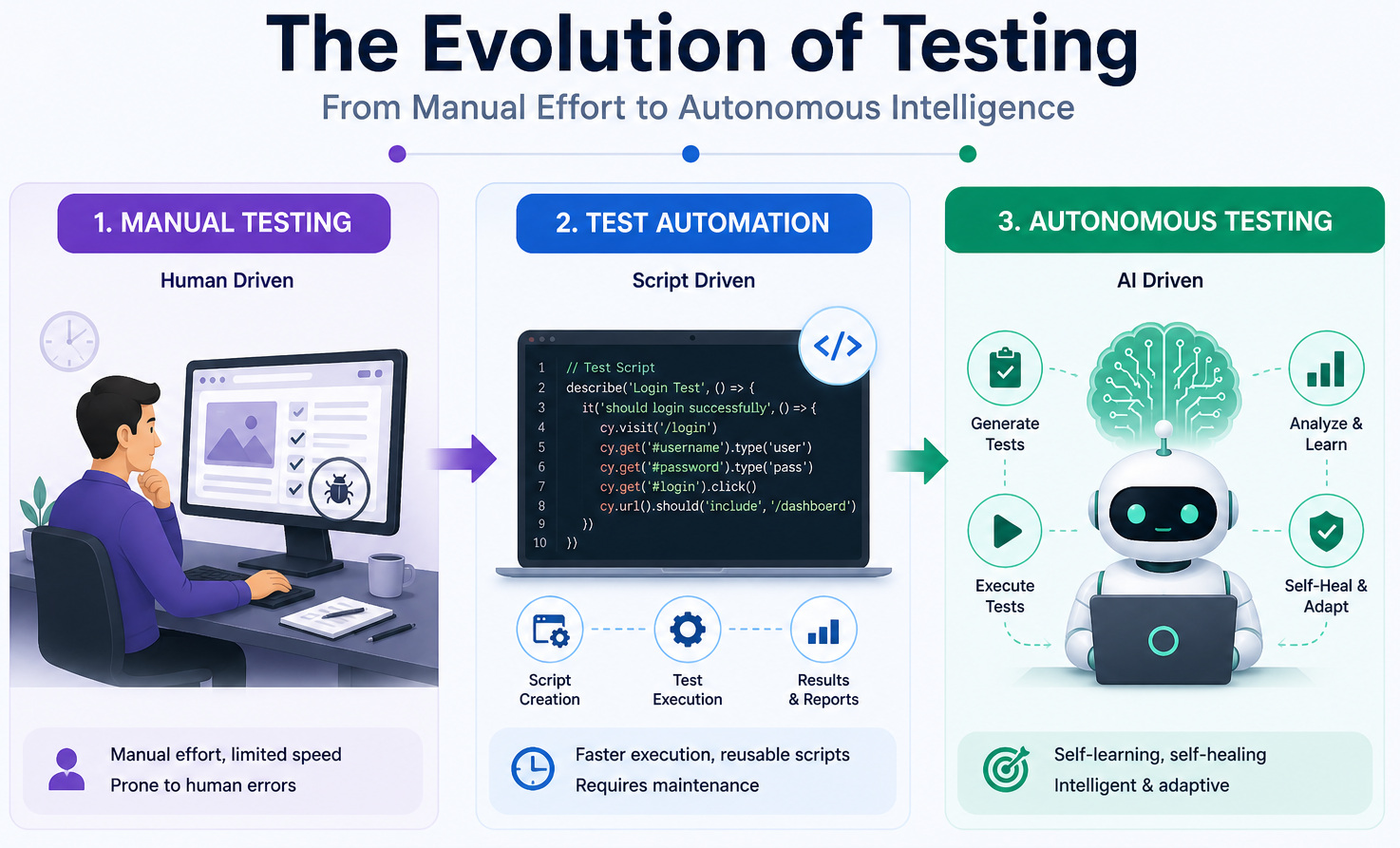
Autonomous testing is a type of software testing that uses Artificial Intelligence (AI) and Machine Learning techniques to automate the testing process. It involves creating and executing test cases, analyzing test results, and reporting defects without human intervention. Autonomous testing handles complex scenarios, adapts to code changes, and optimizes test coverage beyond traditional automation.
In autonomous testing, the testing software can learn from past testing experiences and identify patterns to optimize testing processes. It can also adapt to changing requirements and adjust test cases accordingly. This makes it an efficient and effective testing method. In addition, it can identify defects and potential issues faster than manual testing approaches.
You can apply this to various types of testing, such as functional testing, performance testing, and security testing. It is particularly useful in testing complex and large-scale software applications, where manual testing may be time-consuming and prone to errors.
Key Characteristics
- AI & Machine Learning: Autonomous testing used AI to understand applications, generate tests, and adapt scripts automatically when the UI or code changes.
- Self-Learning & Adaptation: It learns from previous test runs and historical data to improve future tests and identify areas that are risky.
- Minimal Human Intervention: Writing and maintaining complex scripts are done without any human intervention, allowing testers to focus on higher-level strategies.
- Codeless/Scriptless Options: Autonomous testing often enables the creation of tests without extensive coding, making it more accessible to a broader range of team members.
- Intelligent Test Generation: It can analyze requirements and system paths to create relevant test cases, including edge cases, and explore the entire state space.
Test Automation vs. Autonomous Testing
Test automation and autonomous testing are two different approaches to software testing.
Test automation refers to the process of using software tools to automate the execution of test cases and the comparison of actual results with expected results. Test automation can be used for both functional and non-functional testing, such as performance, security, and usability testing. Test automation requires the creation of test scripts, which are used to automate the execution of test cases.
On the other hand, autonomous testing goes a step further. It uses Artificial Intelligence (AI) and Machine Learning (ML) algorithms to create, execute, and analyze test cases without human intervention. Autonomous testing is a form of self-learning testing that can adapt to changing requirements and adjust test cases accordingly.
Test automation is typically focused on repetitive and predictable tasks; autonomous testing can handle more complex and unpredictable scenarios. Autonomous testing also has the potential to discover defects and issues that human testers or traditional test automation tools may miss.
So we can say that test automation and autonomous testing are valuable approaches to software testing. Still, autonomous testing represents a more advanced and sophisticated level of automation that can improve testing efficiency, effectiveness, and accuracy.
The following table summarizes these differences:
| Aspect | Test Automation | Autonomous Testing |
|---|---|---|
| Test Creation | Manual scripting by QA engineers. | AI/ML algorithms automatically generate scenarios. |
| Adaptability | Low | High |
| Human Intervention | Significant human effort for script writing, maintenance, and analysis. | Minimal human oversight, mainly for initial setup and strategic planning. |
| Decision Making | Explicit, pre-programmed instructions (“do X when you see Y”). | Independent decisions and learning from past executions and data analysis. |
| Use Case | Stable applications with repetitive and predictable test requirements (e.g., regression testing). | Complex, dynamic projects in fast-paced DevOps environments |
| Initial Cost | Lower initial cost and simpler to implement. | Higher initial investment in advanced AI tools and infrastructure. |
How to Choose the Right Autonomous Testing Tool in 2026
Autonomous testing tools are often evaluated based on features alone. However, in practice, the choice is usually driven by team structure, technical maturity, and maintenance burden.
- Is test maintenance consuming too much time?
- Are UI changes breaking tests frequently?
- Does the team lack deep automation expertise?
- Is faster release velocity required without increasing QA headcount?
In most cases, a tool is chosen not because it has more features, but because it brings down a particular bottleneck in the testing lifecycle.
Top 5 Autonomous Testing Tools
Let us review the top 5 autonomous testing tools one by one.
testRigor
testRigor is an AI-powered testing system that uses Machine Learning to create, execute, and maintain test cases. It can be used for web, mobile (hybrid/native), desktop, API, mainframe, and database applications. It supports cross-platform and cross-browser end-to-end testing. testRigor uses a no-code testing approach, enabling testers to author tests covering entire user flows in plain English commands. The platform uses a combination of NLP, AI context, generative AI, and Machine Learning algorithms to identify issues in the application, allowing the team to spend up to 95% less time on test maintenance.
Important Features
- No-code, plain-English test scripting that enables business users, QA, and non-technical team members to write comprehensive tests.
- Cross-browser and cross-platform support, including real mobile devices, desktops, mainframes, web, and cloud platforms.
- Advanced AI-powered element identification that uses multiple locators and self-healing mechanisms to reduce flaky tests.
- Supports complex testing scenarios, including two-factor authentication (2FA), email verification, voice/video calls, LLM testing, graphs, images, diagrams, Flutter apps, and chatbot flows.
- Native integrations with CI/CD pipelines (Jenkins, GitHub Actions, Azure DevOps), test management (Jira, TestRail), and device providers.
- Test AI features such as user intent, positive/negative statements, bias, true/false statements, and many more.
Pros
- Reduces test maintenance by up to 99.5% using self-healing and AI-based identification.
- Enables true end-to-end testing, including visual and accessibility testing.
- Supports BDD (Behavior Driven Development)/SDD (Specification Driven Development) out-of-the-box.
- Visual validations without additional plugins using built-in Visual AI.
- Best suited for teams looking to adopt shift-left testing with minimal coding.
- Reusable rules (subroutines) help in reusing the test steps easily.
Teams That Benefit Most
testRigor is well-suited for teams where automation expertise is limited or unavailable. It is often adopted by organizations where test creation needs to be distributed across QA, product, or business teams.
- Startups with limited QA bandwidth
- Teams transitioning from manual to automated testing
- Organizations looking to reduce reliance on scripting
testRigor is an exceptionally good option if test automation is being delayed due to a lack of coding skills. This bottleneck can be eliminated. With testRigor, tests can be written in plain English, allowing broader team participation while reducing maintenance effort.
Appvance IQ
Appvance IQ is an autonomous testing platform that uses AI and Machine Learning to create and execute test scripts. It can be used for both web and mobile applications, supporting various types of testing, including functional, performance, and security testing. The platform uses a model-based testing approach to create test scripts based on the application’s user flows. Appvance IQ can also self-heal test scripts by identifying and fixing issues automatically, making it a valuable tool for continuous testing and integration.
Important Features
- Uses AI-generated tests based on user analytics and usage modeling.
- Supports a wide range of testing types, including functional, performance, load, and security testing in one platform.
- Features an AI-based script with self-healing, enabling automated maintenance.
- Integration with DevOps pipelines and test environments.
- Provides code-based and no-code test authoring options.
- Tests across different browsers and mobile platforms.
- Mimics real user actions for realistic testing.
- Provides real-time insights and error reporting.
- Links with tools like AppDynamics for root-cause analysis.
- Executes tests in parallel and allows for reuse.
Pros
- Excellent for high-frequency CI/CD environments requiring fast feedback.
- Usage-driven testing prioritizes tests based on user impact.
- In-depth analytics and debugging with real-time performance metrics.
Teams That Benefit Most
Appvance IQ is usually used by teams that need large-scale test generation and execution without manually writing every test case. It is often embraced in environments where speed and coverage are prioritized.
- Enterprise QA teams
- Performance-focused organizations
- Teams dealing with large, complex applications
When test coverage is limited due to time constraints, it can be expanded automatically. Appvance IQ generates and executes tests at scale, helping teams uncover issues that might otherwise be missed.
Testim
Testim is an AI-based testing platform that uses Machine Learning to create, execute, and maintain test cases. It employs a codeless testing approach, enabling testers to create test cases without writing code, thereby accelerating testing for web, mobile, and Salesforce applications. In addition, Testim can automatically identify and prioritize high-risk areas of the application, and it can self-heal test cases by adapting to changes in the application. The platform also provides detailed reports and analytics, making it easy for testers to track test results and identify areas for improvement.
Important Features
- Drag-and-drop test creation with visual editing tools.
- Uses dynamic locators and AI algorithms to keep tests robust.
- Users can create entire test suites by providing simple, plain-English descriptions of what they need the test to do.
- Smart prioritization of tests based on code changes and usage patterns.
- Seamless integration with Git, CI tools, and bug trackers.
- Supports reusable test components to speed up creation.
- Supports cross-browser (Chrome, Safari, Edge, Firefox) and parallel testing.
- Provides detailed, built-in reports, including screenshots and logs for failed tests.
Pros
- Great for agile teams needing fast test creation and iteration.
- Strong self-healing capabilities for dynamic UI elements.
- Detailed test analytics and dashboards.
- Good balance between low-code and advanced code customization.
- AI-powered smart locators result in highly stable tests and a reduction in “flaky” tests.
- The platform has reliable support and extensive documentation.
Teams That Benefit Most
Testim is good for teams that need a balance between speed, flexibility, and control. It is often selected by teams that want to move faster without completely giving up code-based customization.
- Agile teams with fast release cycles
- QA teams working closely with developers
- Organizations needing scalable UI automation
If tests are regularly breaking due to UI changes, stability can be improved. Testims smart locators help make sure that minor changes do not result in repeated test failures.
Mabl
Mabl is an AI-driven test automation platform that utilizes machine learning to create and execute test scripts. It uses a model-based testing approach to generate test scripts based on the application’s user flows. As a result, Mabl can automatically identify and fix issues in the application, making it a valuable tool for continuous testing and integration. The platform also provides detailed analytics and insights, making it easy for testers to identify areas for improvement.
Important Features
- Auto-detection of UI changes and test adaptation.
- Built-in support for API, performance, and accessibility testing.
- Fully cloud-based test execution with parallel runs.
- Model-based test generation and change impact analysis.
- Powerful visual dashboards and error clustering
- Seamless integration with CI/CD tools (Jenkins, GitHub Actions, GitLab, etc.) and issue trackers like Jira and Slack, enabling continuous testing.
Pros
- Ideal for DevOps teams practicing continuous delivery.
- Simplifies test creation and execution for non-engineers.
- Strong integration ecosystem (Jira, GitHub, Slack, Bitbucket).
- Supports data-driven testing with built-in test data generation.
- Accelerates test creation and maintenance through a low-code interface and AI features.
- Provides actionable Insights with rich data and diagnostics, such as performance anomaly detection and visual change detection.
Teams That Benefit Most
Mabl is mostly adopted by teams practicing continuous testing within CI/CD pipelines. It is particularly useful where test maintenance effort is becoming difficult to manage.
- DevOps-driven teams
- SaaS companies with frequent releases
- Teams aiming to reduce flaky tests
If QA cycles are being delayed by unstable tests, that friction can be reduced. With Mabl, tests are automatically adapted to UI changes, improving reliability across releases.
Functionize
Functionize is an autonomous testing platform that uses AI and Machine Learning to create and execute test cases. It uses a model-based testing approach that enables it to automatically create test scripts based on the application’s user flows. Functionize can automatically identify and adapt to changes in the application, making it a valuable tool for continuous testing and integration. The platform also provides detailed reports and analytics, making it easy for testers to track test results and identify areas for improvement.
Important Features
- Converts natural language instructions into executable tests.
- Performs complex tasks such as root cause analysis using autonomous agents.
- Uses AI/ML to detect application changes and auto-update test flows.
- Provides rich test insights, performance metrics, and visual reports.
- Offers a Smart Record and Playback system with a cloud test grid.
- Supports API, database, and load testing through extensions.
- Offers scalable, parallel test execution across various browsers and devices.
- Provides one-click fixes (SmartFix) and detailed screenshots/comparisons to identify failures quickly.
Pros
- Ideal for cross-functional teams with both technical and non-technical contributors.
- Strong focus on reducing manual test creation and updates.
- Well-suited for scaling test automation across large apps and teams.
- Provides visual test debugging with actionable trace logs and screenshots.
Teams That Benefit Most
Functionize is good for organizations that need end-to-end test automation with minimal scripting effort, while still maintaining enterprise-level coverage.
- Large organizations with complex workflows
- Teams looking for NLP-based test creation
- QA teams aiming to scale automation quickly
If automation coverage is low because writing tests takes too long, that gap can be addressed. Functionize enables tests to be created using natural language, allowing faster expansion of test suites.
Top 5 Benefits of Autonomous Testing
- Testing Efficiency: They can execute test cases faster and more accurately than human testers or traditional test automation tools. This can reduce the time and effort required for testing, enabling faster delivery of software applications.
- Better Test Coverage: These tools can create and execute a large number of test cases, covering various scenarios and edge cases that human testers may miss. This can help improve the quality and reliability of the software application.
- Less Testing Costs: Can reduce the cost of testing by eliminating the need for human testers and manual test script creation. It can also help identify defects and issues earlier in the development cycle, reducing the cost of fixing defects.
- Continuous Testing: Can be integrated with continuous integration and continuous delivery (CI/CD) pipelines to enable continuous testing throughout the software development lifecycle. This can help identify defects and issues earlier in the development cycle, improving the speed and quality of software delivery.
- Adaptability and Flexibility: It can adapt to changing requirements and adjust test cases accordingly, making it a valuable tool for agile and DevOps environments. It can also handle more complex and unpredictable scenarios, providing greater test coverage and accuracy.
- Test AI Features: These AI-based test automation tools help you easily test the AI features of applications. Read: Top 5 AI Testing Tools – Overview.
Autonomous Testing: Challenges
- Initial Investment: These tools often require a significant upfront investment in the tool and the resources needed to implement and configure it. This can be a barrier for smaller organizations or those with limited budgets.
- Lack of Human Judgment: They need the human judgment and intuition that human testers bring to the testing process. This can lead to false positives or negatives, and it can be challenging to identify and correct issues that the tool needs to detect.
- Limited Scope: These tools are typically designed to test specific types of applications or scenarios. This can limit their effectiveness for testing more complex or unique applications or scenarios.
- Complexity: Autonomous testing tools can be complex and require specialized skills and knowledge to implement and use effectively. This can be a barrier for organizations that lack the necessary resources or expertise.
- Data Dependency: AI models require vast amounts of high-quality, unbiased data to train effectively, which can be hard to source.
- Complex & Dynamic UIs: Modern applications with constantly changing user interfaces are difficult for autonomous systems to interact with reliably.
- Security & Privacy: It is challenging to ensure the security of test frameworks and handle sensitive data, as it adds complexity, especially with advanced AI.
How to choose in 2026 (a practical shortlist method)
- Run a UI-change resilience test: To measure how many tests have self-healed and how many required edits, intentionally change locators/components. (This is where “autonomous” earns its keep.)
- Measure time-to-first-meaningful-suite: Is it possible for a small team to produce a stable smoke/regression pack quickly?
- Validate diagnosis quality: During failures, do you just get “element not found” or any actionable root-cause signals?
With information obtained from these considerations, you can make a decision to choose an appropriate autonomous testing framework.
Conclusion
So, autonomous testing is an innovative approach to software testing that uses Artificial Intelligence and Machine Learning techniques to automate the testing process. It is a more advanced and sophisticated level of automation that can improve testing efficiency, effectiveness, and accuracy. It offers many benefits, such as improved testing efficiency, enhanced test coverage, reduced testing costs, continuous testing, and adaptability and flexibility.
However, there are also challenges associated with autonomous testing, such as the initial investment in tools, the need for specialized skills, the risk of over-reliance on technology, and the potential for bias in testing. Despite these challenges, autonomous testing is expected to play an increasingly important role in software development in the coming years.
Frequently Asked Questions (FAQs)
- Are autonomous testing tools suitable for small teams?
A: Yes, especially for small teams where QA resources are limited. In many cases, test creation and maintenance can be partially automated, reducing manual effort.
- Do autonomous testing tools completely replace QA engineers?
A: No. While effort is reduced, human validation is still required. These tools are best seen as augmentation rather than replacement.
- Why are teams moving toward autonomous testing tools?
A: Autonomous testing tools are being adopted because test maintenance has become a major bottleneck. With frequent UI and code changes, traditional automation often requires constant updates, which can slow down releases.
- How is autonomous testing different from AI-assisted test automation?
A: AI-assisted automation helps improve specific parts of testing (like self-healing or smarter locators), while autonomous testing goes further by creating, executing, maintaining, and optimizing tests with minimal human involvement.