Over the last 20 years, software development has evolved at a sonic pace to deliver high-quality software quickly while ensuring close stakeholder involvement. Acceptance Test Driven Development (ATDD) is a collaborative practice that closes the gap between business expectations and technical implementation. It is one of the many methods that have helped mold modern Agile practices.
| Key Takeaways: |
|---|
|
In this article, we will go over what ATDD is, how it works, its benefits, how it fares against related methods like TDD and BDD, and the best practices that can aid teams in implementing it successfully.
What is Acceptance Test Driven Development (ATDD)?
ATDD can be simply defined as: Defining “what” before “how.”
At its core, it is a software development method in which tests (called acceptance tests) are defined prior to the initiation of development. Thus, instead of jumping directly to coding, teams first discuss and document how a specific feature should behave from the end user’s or business stakeholder’s perspective. The observations obtained from these brainstorming sessions are captured as acceptance tests that serve both as requirements and validation criteria.
Contrary to traditional approaches where requirements are written in lengthy documents and tested later, ATDD integrates requirements, development, and testing into a continuous, collaborative process.
The acceptance tests guide development as well as verify correctness and become a single source of truth.
Key Participants in ATDD (Three Amigos)
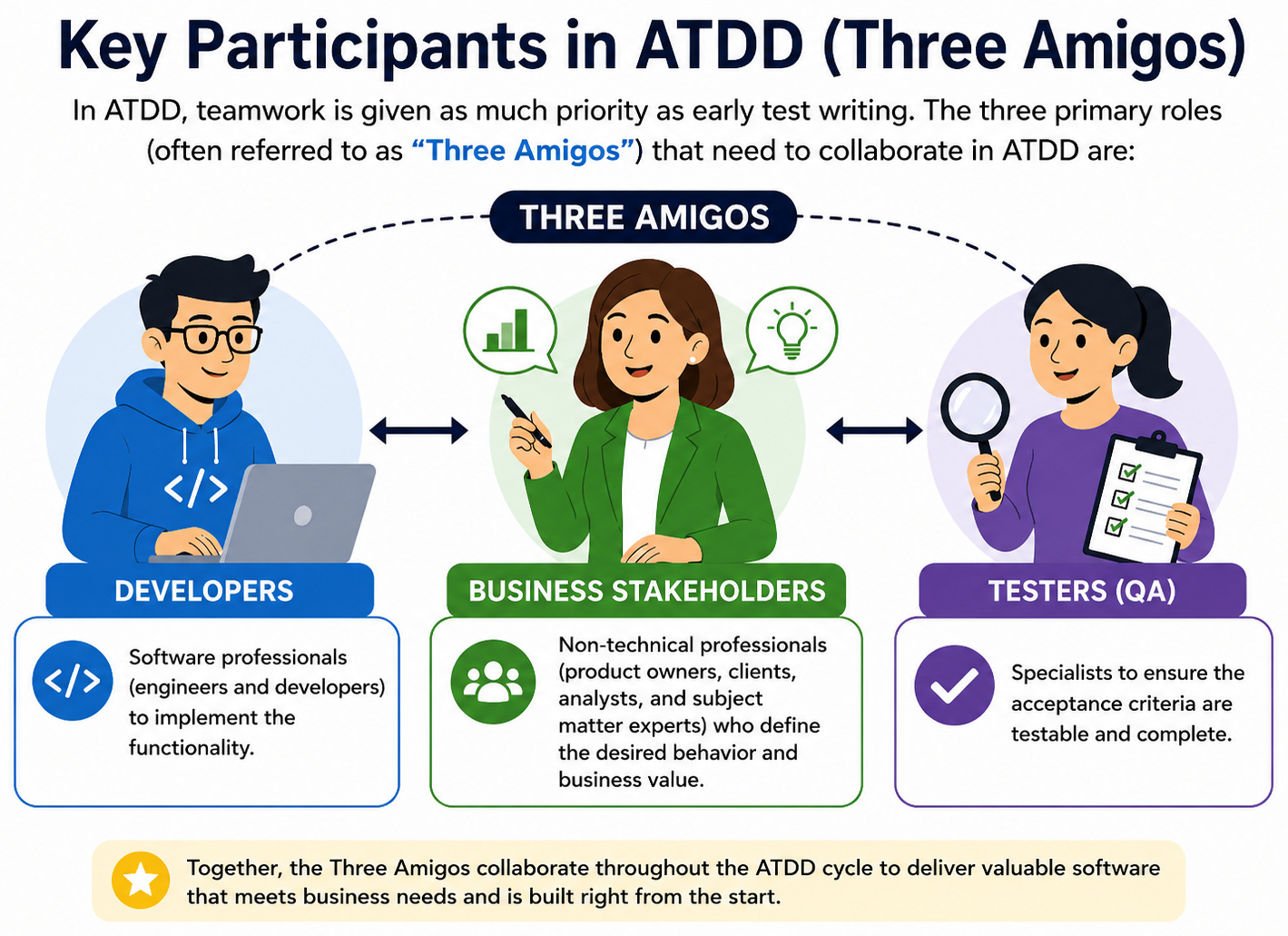
- Developers: Software professionals (engineers and developers) to implement the functionality.
- Business stakeholders (product owners, clients, analysts, and subject matter experts): Non-technical professionals who define the desired behavior and business value.
- Testers (QA): Specialists to ensure the acceptance criteria are testable and complete.
The collaboration between these three amigos ensures that requirements are testable, clear, and aligned with business requirements before development commences.
The ATDD Process
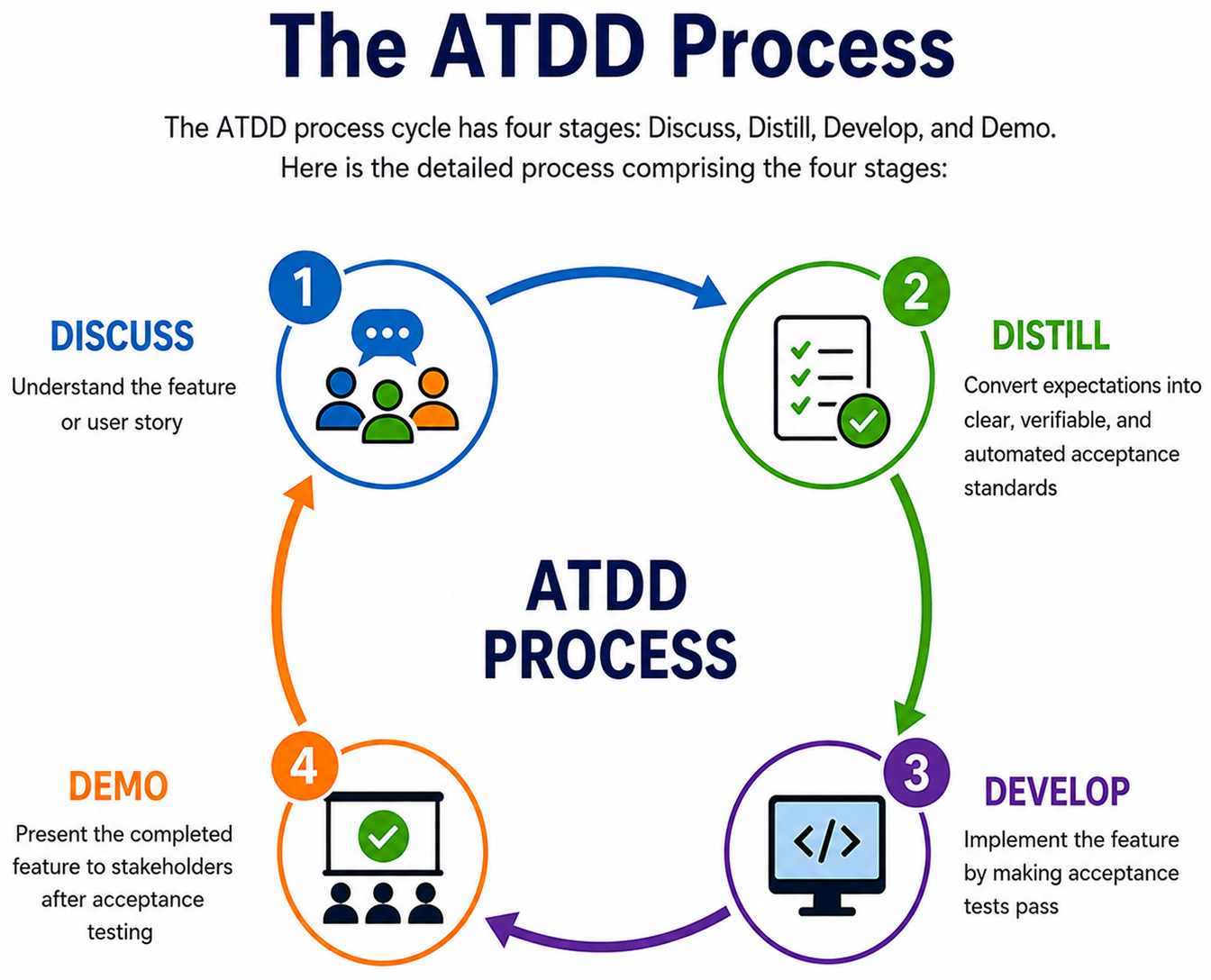
- Discuss: This is the first step in the ATDD cycle and is performed to understand the feature or user story. In this stage, stakeholders, developers, and testers collaborate and reach an agreement on expected results and resolve discrepancies, if any.
The team collaboratively discusses a user story to understand:
- What problem is being solved or what feature is to be implemented?
- What are the expected results?
- What are edge case scenarios?
- Distill: Once the group discussion is over, these expectations are converted into clear, verifiable, and automated acceptance standards. The acceptance criteria, which define the behavior of the system, are written in a structured, testable format.
- Develop: Developers then start implementing the feature. As acceptance tests are written before implementation, these tests:
- Fail initially (since functionality doesn’t exist yet)
- Serve as a guide for development
- Developers write code to make the acceptance tests pass.
- Demo: Once acceptance tests pass, stakeholders are presented with the completed feature after acceptance testing confirms that all requirements have been met.
This practice ensures that features are built only after their expected behavior and success criteria are clear.
Building Acceptance Tests: Given-When-Then
Acceptance tests are often written in a behavior-driven format using natural language (the Gherkin syntax). A common structure is:
Given - When - Then
Where,

Given: Defines the initial context

When: Specifies action performed

Then: Provides expected outcome
The Gherkin syntax ensures that the acceptance criteria are clear, testable, and written in simple terms, so that all team members, including non-technical stakeholders, can understand them.
Example
To better understand the Gherkin syntax, consider the following example:
Given the user is on the login page
When they enter valid credentials
Then they should be redirected to the dashboard on successful
     login
As you can see, this test is readable and clear enough for both technical developers and non-technical stakeholders.
ATDD is not limited to the Gherkin syntax alone, though it is a popular choice. The acceptance criteria can be described in various formats, such as simple plain text, spreadsheets, user stories, or other structured documents, as long as they clarify requirements and enable communication among the team.
ATDD vs TDD vs BDD: The Clear Difference
TDD (Test-Driven Development), BDD (Behavior-Driven Development), and ATDD (Acceptance Test-Driven Development) are “test-first” methodologies with different focuses.
While TDD ensures code correctness at the unit level, BDD defines system behavior using natural language for collaboration. ATDD validates business requirements via stakeholder-defined acceptance criteria.
- Test-Driven Development (TDD): Unit tests should be written before code, as per TDD. Although it ensures accuracy at a technical, code-level granularity, it doesn’t guarantee that the feature aligns with the user’s needs.
- Behavior-Driven Development (BDD): The objective of BDD is to define behavior in a manner that is clear to business people. One example of this is the utilization of Gherkin syntax, such as Given-When-Then. It places strong emphasis on collaboration and mutual understanding and, in fact, closely resembles ATDD.
- Acceptance Test-Driven Development (ATDD): The main focus of ATDD is the acceptance criteria derived from business goals. Validating that user stories are implemented as intended ensures the system delivers business value.
In conclusion, ATDD validates customer expectations, BDD validates system behavior, and TDD validates the code.
| Feature | TDD | BDD | ATDD |
|---|---|---|---|
| Primary Goal/Focus | Code correctness | System behavior and communication | Business requirement |
| Perspective | Developer | User/Behavior | Business/Stakeholder |
| Question | Is the code working? | Does it behave as expected? | Are we meeting requirements? |
| Language | Programming language | Plain English (Gherkin) | Plain English/Structured |
| Key Stakeholder | Developers | “Three Amigos” (Dev/QA/PO) | Business User/PO/Developers/QA |
| Level | Unit | Acceptance + Collaboration | Business acceptance |
Benefits of Acceptance Test-Driven Development
- Improved Cooperation: ATDD demands proactive collaboration between developers, testers, and stakeholders. This ensures role-to-role alignment and removes ambiguities early. There are considerably fewer misunderstandings related to requirements.
- Clearer Requirements: Teams should avoid insufficient or ambiguous user stories by conveying requirements as acceptance tests. Acceptance tests offer a single source of truth because they clearly define exactly what needs to be done and act as precise, unambiguous requirements.
- Proactive Detection of Issues: Probable requirement gaps or discrepancies are detected early. As the acceptance criteria were established well before development began, the issues can be resolved at minimal cost.
- Living Documentation: Acceptance tests offer current documentation of the system functionality. Executable acceptance tests evolve as the product evolves, unlike conventional documents that quickly become outdated and useless.
- Increased Client Satisfaction: Software that closely matches the user expectation is built when acceptance criteria are created in collaboration with stakeholders. This increases satisfaction and trust.
Common ATDD Tools
- Cucumber: Automates Given-When-Then scenarios using Gherkin syntax. More popular for BDD.
- SpecFlow: A Cucumber-inspired .NET framework.
- FitNesse: A wiki-based acceptance test writing framework.
- Robot Framework: A general framework for test automation that utilizes keyboard-driven testing.
- Gauge: A lightweight tool for building business-readable acceptance criteria.
- Behave (Python): BDD/ATDD framework.
In addition, modern low-code and no-code test automation tools are steadily entering the ATDD market. It is easier for non-technical stakeholders to contribute to test creation while still integrating into CI/CD pipelines, for example, when teams use tools like testRigor to describe acceptance tests in plain English.
Challenges in ATDD
- Initial Learning Curve: Teams unfamiliar with the ATDD method may find it cumbersome to write accurate yet non-prescriptive acceptance tests.
- Collaboration Discipline: All three roles of developers, testers, and stakeholders must be dedicated to success. ATDD fails to be efficient if one group stops contributing.
- Tooling Setup: Incorporating acceptance testing tools into existing methods can be cumbersome, especially in large, complex systems. Automation frameworks may require setup and maintenance.
- Test Maintenance: Acceptance tests need to adapt as systems evolve. Tests can become brittle or outdated without frequent maintenance.
- Cultural Shift: Teams must embrace collaboration and shared responsibility, which may require mindset changes.
- Skill Gaps: Stakeholders must learn to write clear, testable acceptance criteria.
Best Practices for ATDD
- Start Small: To steer ATDD, start with an individual feature or user story before scaling to other projects.
- Involve Stakeholders Early: Ensure that organization representatives take an active role in building the acceptance criteria and business, QA, and development collaborate from the start.
- Keep Tests High-level: Pay close attention to outcomes and business value rather than focusing on implementation specifics. Avoid overly technical language in acceptance tests.
- Automate Where Possible: Automated tests provide faster feedback and stability. Integrate acceptance tests into CI/CD pipelines by automating them using tools such as Cucumber, Robot Framework, or testRigor.
- Review Tests Regularly: Treat acceptance tests as living documents that should be updated as requirements change.
Example: ATDD in Action
Let’s consider an e-commerce checkout feature to demonstrate ATDD.
User Story:
As a customer, I want to apply a discount code to reduce my total price.
- Valid discount codes reduce the total price of a product
- Invalid codes show an error message
- Expired codes are rejected
Scenario 1: Valid Discount Code
- Given the cart total is $100
- When the user applies a 10% discount code
- Then the total should be $90
Scenario 2: Invalid Discount Code
- Given the cart total is $100
- When the user applies an invalid code
- Then an error message should be displayed, and the cart total is $100
Developers implement the feature until these tests pass.
Measuring Success in ATDD
- Reduction in defects
- Faster delivery cycles
- Improved stakeholder satisfaction
- Test coverage of acceptance criteria
- Reduced rework
ATDD in Agile and DevOps
Agile and DevOps principles are naturally aligned with ATDD. Agile ensures that user stories are clear and testable prior to development. Automated acceptance tests are integrated into the continuous integration and delivery (CI/CD) process in DevOps to make sure that new code doesn’t impact existing features or deviate from corporate goals.
Organizations can boost confidence in production deployments and accelerate feedback loops by incorporating acceptance tests into their pipelines.
Future of ATDD
- Increased automation using AI-powered testing tools
- Integration with low-code/no-code platforms
- Enhanced collaboration tools
- Shift-left testing is becoming a standard practice
Organizations adopting ATDD are better equipped to deliver high-quality software rapidly and consistently.
Read: Top 6 Codeless Test Automation Tools of 2026.
Conclusion
Acceptance Test-Driven Development (ATDD) is a framework for collaboration that ensures software development is driven by actual business requirements. ATDD brings down misunderstandings, encourages shared ownership, and builds software that closely matches user expectations by involving stakeholders, developers, and testers with an upfront definition of acceptance criteria.
Clearer requirements, increased customer satisfaction, and early feedback are all benefits of ATDD. Initiating minor, automating acceptance tests with relevant tools, and integrating those tests into Agile and DevOps processes can aid teams in adopting ATDD efficiently in the long run.
Frequently Asked Questions (FAQs)
- Why are acceptance tests written before development?
Writing tests before development ensures requirements are clear, prevents misunderstandings, and guides developers in building the correct functionality from the start.
- Does ATDD slow down development?
It may seem slower initially due to upfront discussions and test writing, but it speeds up development in the long run by reducing bugs and rework.
- What types of projects benefit most from ATDD?
Projects with complex business logic, high stakeholder involvement, or critical user requirements benefit the most from ATDD.
- Are acceptance tests always automated?
Not always. While automation is recommended for efficiency and scalability, some acceptance tests can remain manual depending on complexity and context.
- How does ATDD improve communication?
ATDD encourages early collaboration among stakeholders, ensuring everyone shares a common understanding of requirements before development begins.