
Agile development methodology has transformed the way software teams build, test, and release products. With Agile’s features consisting of shorter development cycles, continuous delivery pipelines, and rapid customer feedback loops, defects are no longer treated as isolated issues discovered at the end of a project. Instead, they become part of an ongoing quality management process. The way we handle defects in Agile has undergone a transformation.
| Key Takeaways: |
|---|
|
This guide explains the modern Agile defect management process, best practices, workflows, and tools that help teams efficiently handle defects while maintaining continuous delivery and customer satisfaction.
What are Defects in Agile?
A defect is any deviation (error or failure) between expected and actual system behavior. It is a result of code errors, incorrect logic, inadequate implementation, or unexpected issues between various software components. Defects reduce the practical value of software, leading to unpredictable results and poor and slow performance. Read more on Defect Lifecycle.
- Functional Defects: These are the issues that occur in the software when features fail to work according to requirements. For example, a login button redirects users to the wrong page.
- Performance Defects: When applications fail to perform and respond slower than acceptable thresholds, they have performance defects. When a search query that ideally is expected to complete in two seconds takes 15 seconds, the application has performance issues.
- Security Defects: These are the vulnerabilities that expose software applications to potential attacks. For example, improper authentication can lead to unauthorized access.
- Usability Defects: When the application creates user confusion or poor usability experiences, these are usability issues. One such example is a checkout process that requires unnecessary steps.
- Integration Defects: When systems fail to communicate with each other correctly, integration issues arise. As a result of integration defects, payment processing may fail when interacting with third-party APIs.
By gaining thorough knowledge of defects and their types, teams can prioritize and route issues effectively.
Refer to Software Defects and Their Different Types for more information on defects.
- Requirement reviews
- Development activities
- Unit testing
- Integration testing
- System testing
- User Acceptance Testing (UAT)
- Production monitoring
- Customer feedback
In Agile, defect resolution is not postponed until the testing phase, as is done in traditional Waterfall methodologies. Instead, Agile treats quality as a shared responsibility across the entire team, and defect resolution is a continuous process.
Why Defect Management Matters in Agile?
All kinds of businesses require high-quality software and happy users. To achieve this goal, most companies adopt defect management practices. In Agile, new iterations arrive quickly, and many of us assume defects are fixed later. But this is not the case. In reality, defects that are found later in the development lifecycle cost significantly more to fix than those identified earlier. Hence, defect management is very important.
- Reduced product quality
- Missed sprint goals
- Technical debt accumulation
- Increased maintenance costs
- Customer dissatisfaction
- Security vulnerabilities
- Delayed releases
- Detect defects early
- Fix issues quickly
- Prevent recurrence
- Maintain release velocity
- Improve overall product quality
- Teams can quickly identify and address issues and enhance the speed and effectiveness of defect resolution through effective defect management.
- Defect management encourages cross-team collaboration by helping QA, development, and testing teams work together smoothly to resolve issues.
- It prioritizes and fixes issues quickly, allowing teams to deliver high-quality software faster.
- Defect management contributes to more reliable, stable software by supporting a structured, systematic approach.
- Teams can analyze and understand the root causes of defects. This helps teams proactively prevent similar issues, reducing risk.
- Companies can prioritize defect management and consistently focus on quality throughout the project, with issue management in place.
The Agile Defect Management Lifecycle in 2026
Modern Agile teams typically follow a structured defect management lifecycle.
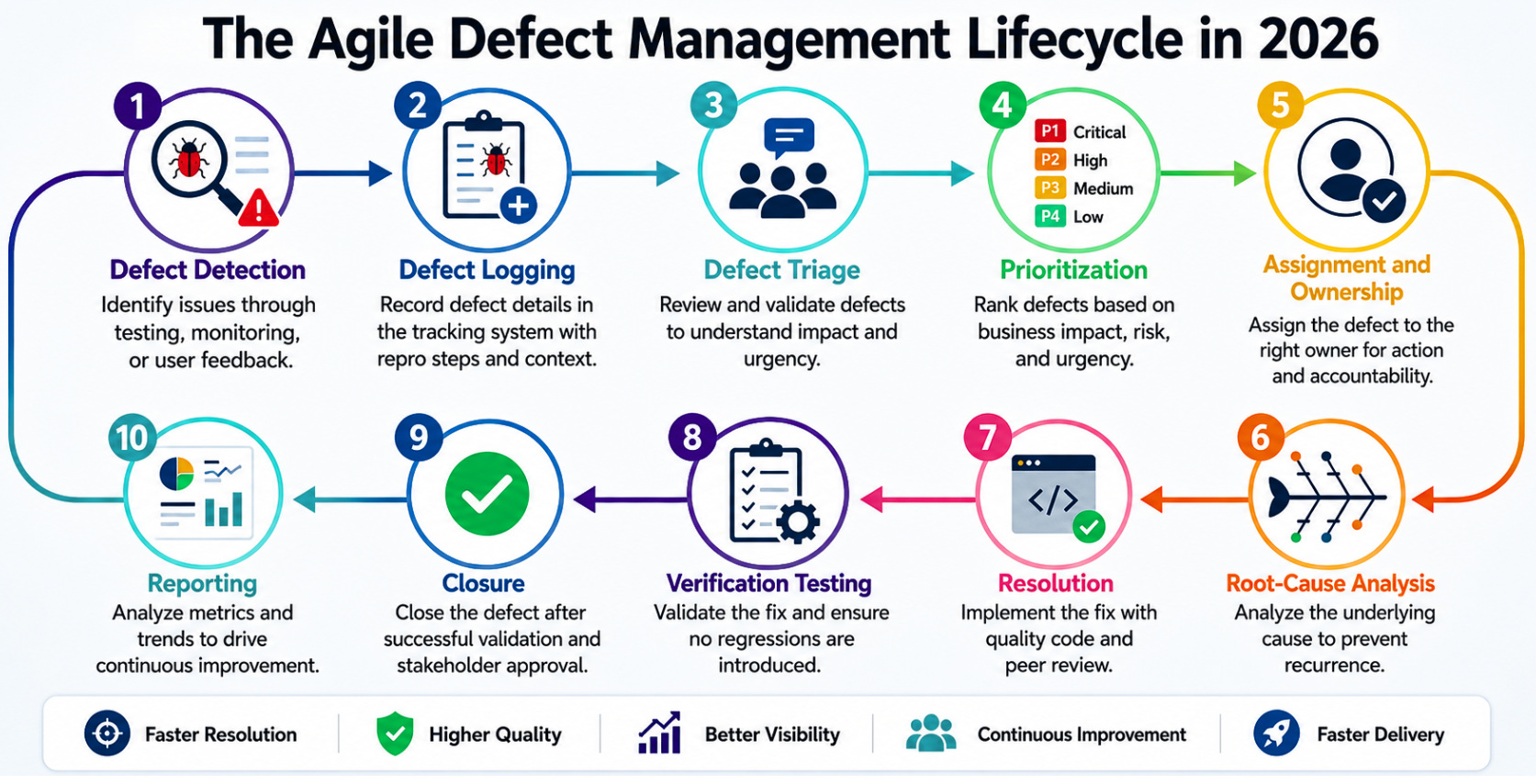
1. Defect Detection
At this step, teams primarily focus on identifying as many errors as possible early in the software development process. Various types of testing, unit, integration, and acceptance testing are performed.
- Automated testing
- Manual testing
- Production monitoring
- Customer reports
- AI-driven anomaly detection tools
The goal at this stage is to capture enough information about the identified defect for investigation. Detailed defect information includes defect title, description, environment, steps to reproduce, expected result, actual result, screenshots or logs, and severity level.
A defect that has all the above information is well-documented and significantly reduces investigation time.
2. Defect Logging
At this step, the defects identified should be recorded in a centralized tracking system. QA testing teams document and record identified issues. The defect information gathered in the previous step will be used to prioritize and assign errors for further fixing.
Popular defect tracking tools such as Jira, Azure DevOps, GitHub Issues, Linear, or ClickUp can be used for logging defects.
After it is logged, each defect receives a unique ID, reporter information, defect creation timestamp, priority, severity, and sprint association.
Modern AI-enabled tools automatically classify defects and often suggest duplicate issues.
3. Defect Triage
Defect triage determines how urgently the issue needs attention and how quickly it can be fixed. It is the process of reviewing reported defects to determine their severity (critical, major, minor, or trivial), priority (low, medium, high, or urgent), business impact, and resolution timeline. Agile teams often conduct regular triage sessions weekly or multiple times per sprint to ensure critical issues receive immediate attention.
Participants in triage sessions typically include Product Owner, QA Engineers, Developers, Scrum Master, and Engineering Managers.
- Does the defect impact customers?
- Is there a workaround?
- Does it affect revenue?
- Is production impacted?
- Does it block testing?
After triage sessions, the team decides if the defect is to be fixed immediately, scheduled for the next sprint, added to the backlog, rejected as invalid, or marked as a duplicate.
4. Prioritization
- Critical: The issues like system outages, security breaches, or payment failures that jeopardize the application functionality are considered critical defects and should be prioritized to be fixed immediately.
- High: Whenever there are situations where a core business functionality is broken, such a defect is considered a high priority. Such a defect should be fixed in the current sprint, but not necessarily immediately.
- Medium: Issues like partial feature failures have medium priority as they do not affect the overall application functionality. Such issues can be taken up for the upcoming sprint.
- Low: The lowest priority issues are cosmetic UI issues like spelling mistakes or color coordination that do not affect the functionality of the application. Such issues are normally added to the defect backlog for later refinement.
Prioritization primarily focuses on business impact rather than technical complexity.
5. Assignment and Ownership
In this step, the logged issue is assigned to a specific developer or team. The assigned developer or team has ownership of this defect and will be responsible for resolving it.
The defect owner is responsible for issue investigation, root-cause analysis, issue resolution, and testing support. Lack of defect ownership often leads to sprint delays and unresolved issues.
While assigning an issue to a specific developer or team, you should consider the expertise, workload, and severity of the issue. You should also try to prevent developer burnout and maintain productivity. Automated notifications and reminders should be implemented to ensure the timely resolution of issues.
6. Root-Cause Analysis
This is the step where the root cause of the defect is investigated because fixing symptoms without understanding the cause leads to recurring defects.
Defect Root Cause Analysis (RCA) is a systematic problem-solving approach that identifies the underlying origin of a flaw or failure, rather than merely treating its symptoms. The goal of RCA is to implement permanent corrective actions so that the fix improves overall system quality, boosts reliability, and prevents defect recurrence.
- Why did the issue occur?
- Why wasn’t it detected earlier?
- Which process failed?
- Five Whys: This is an iterative interrogation technique to explore the cause-and-effect relationships underlying a specific problem. A question, “Why,” is asked roughly five times, and teams can reveal the layers of symptoms and identify the root cause.
- Fishbone Diagrams: This is a visual diagram that categorizes potential contributing factors, such as Manpower, Machine, Material, Method, Measurement, and Milieu/Environment. This helps to identify where a process broke down.
- Fault Tree Analysis (FTA): This is a top-down, deductive failure analysis in which an undesired state of a system is analyzed using Boolean logic to combine a series of lower-level events.
- Production Incident Reviews: This technique is used for critical customer-facing issues. Its objective is continuous improvement rather than individual criticism.
7. Resolution
Once the priority is assigned to the defect and the RCA is conducted, the assigned developer works on the solution to resolve the bug.
The resolution is based on the severity of the defect and marks the critical phase in the defect management process. Developers may use automated testing tools and frameworks to resolve defects more quickly and efficiently.
- Creating automated tests first
- Following coding standards
- Performing peer reviews
- Updating documentation
As of 2026, with more innovation in AI, AI-assisted coding tools frequently help developers generate fixes and identify potential side effects. However, human review still remains essential.
8. Verification Testing
- The defect is fixed
- No regressions were introduced
- Acceptance criteria are satisfied
Verification may include functional testing, integration testing, API testing, regression testing, and performance validation. Most Agile organizations opt for automated test execution.
9. Closure
A defect is closed when the fix is deployed, testing has passed, and stakeholders approve the resolution.
Closure should include documentation of root cause, fix summary, and validation evidence.
- Gather final approvals from relevant stakeholders, testers, and QA leads to verify that the issue has passed all necessary retesting, regression testing, and has met established closure criteria.
- Update documentation and issue status in the tracking system.
- Review the issue to see if it reveals anything that could help in future process improvement.
10. Reporting
At this stage, a well-structured defect report is prepared to identify trends and root causes as well as discover areas of process optimization.
- Identify quality trends and patterns in recurring issues by analyzing where these defects occur. This helps teams identify potentially vulnerable areas and focus future testing on high-risk zones.
- Perform root cause analysis to uncover reasons for design flaws, coding errors, or insufficient test coverage to be shared with development and testing teams.
- Evaluate testing strategy for better coverage and early issue detection for future cycles.
- Track metrics such as defect density and leakage rates to quantify software quality and identify areas for improvement.
- Prepare for release by tracking the status of issues against the release criteria. If certain defects cannot be fixed in time, teams must decide whether to release or delay.
Defect Management Within Scrum
Scrum teams often ask whether defects belong in the backlog.
The answer depends on severity and impact.
Defects Found During the Sprint
In Scrum, defects are treated as unplanned work that disrupts the Sprint Goal. Actionable management requires logging bugs in the Product Backlog, triaging them based on severity and impact, and prioritizing fixes collaboratively between the Product Owner and the Development Team.
- Defects Found During the Sprint: Issues marked critical should typically be addressed immediately. Minor issues may be added to the sprint backlog or scheduled for future sprints.
- Defects Found After Sprint Completion: Such issues usually enter the product backlog and compete with other issues/features based on priority. Some may be scheduled for future sprints.
Many organizations establish Service Level Agreements (SLAs) for defect resolution. This prevents defect accumulation. For example, the issues are categorized as per their severity/priority and assigned a target resolution time shown in the table below:
| Priority | Target Resolution |
|---|---|
| Critical | 24 Hours |
| High | 3 Days |
| Medium | 1 Sprint |
| Low | Backlog |
Shift-Left Testing and Defect Prevention
Modern Agile teams emphasize defect prevention heavily. One approach to defect prevention is shift-left testing.
Shift-left testing is a testing approach that moves quality assurance and testing activities to earlier phases in the Software Development Lifecycle (SDLC). Thus, instead of waiting for a completed build to run tests, it integrates testing, security, and validation early and often to prevent defects rather than just finding them.
- Requirement validation
- Static code analysis
- Unit testing
- Contract testing
- Security scanning
Shift-left testing provides faster feedback, lower fixing costs, reduced rework, and improved quality. This significantly reduces production defects.
AI-Powered Defect Management in 2026
In 2026, AI-powered defect management has transitioned from reactive bug tracking to proactive quality intelligence. Intelligent AI-based systems now feature self-healing test automation, computer vision that catches micro-flaws at production-line speeds, and predictive root-cause analysis, shaping the defect handling.
- Defect Classification: AI automatically categorizes defects by their severity, priority, risk, and component.
- Duplicate Detection: Machine learning (ML) identifies similar historical defects.
- Root-Cause Suggestions: AI can analyze logs, code changes, and test failures to suggest probable causes of defects.
- Predictive Quality Analytics: Advanced AI platforms predict high-risk releases, defect-prone modules, and vulnerable code areas.
AI accelerates defect management but should augment, rather than replace, human decision-making.
Defect Metrics Every Agile Team Should Track
Agile defect metrics help teams prioritize and improve quality continuously without sacrificing speed. By tracking when and how bugs are introduced and resolved, teams can identify process bottlenecks, improve test automation, and prevent issues from reaching end users.
- Defect Density: This metric measures the defects relative to code size. The measure is given by:
Defects / KLOC (Thousand Lines of Code)Lower values calculated generally indicate better quality. - Defect Leakage: This metric measures the number of defects that escape into production.
The measure is given by:
Production Defects / Total DefectsHigh leakage suggests gaps in QA and testing. - Mean Time to Resolution (MTTR): MTTR measures how quickly the defects are fixed. MTTR is given by:
MTTR = Total Resolution Time / Number of Resolved DefectsLower MTTR indicates efficient processes. - Reopened Defects: This metric tracks the defects requiring additional fixes.
When the number of reopened defects is high, it indicates poor testing, incomplete fixes, and misunderstood requirements.
- Defect Aging: The defect aging metric measures how long the defect has remained unresolved. If the defects are older, they become technical debt. Aging should be monitored to maintain backlog health.
Refer to Important QA Metrics to Know to read more about metrics.
Common Defect Management Challenges
- Defect Backlog Growth: Sometimes defects accumulate faster than they are resolved, mainly due to inadequate sprint capacity, incorrect prioritization, or automation limitations.
- Poorly Documented Defect Reports: If defect reports lack vital context, such as clear steps to reproduce the issue, screenshots, or system logs, it may pose a challenge for developers as they waste time seeking clarifications, and testers experience delayed resolution times.
- Misaligned Prioritization and Severity: Relevant stakeholders, such as testers, developers, and other professionals, may differ in their assessment of an issue’s severity during the triage process. This can stall resource allocation and may result in critical defects being overlooked or minor bugs being over-prioritized.
- Conflicts Between Features and Fixes: Teams often prioritize new feature development over quality. This is a challenge as existing defects may remain in the release.
- Lack of Root-Cause Analysis: Defect recurrence indicates systemic issues, such as insufficient RCA for major incidents.
- Insufficient Automation: Manual testing alone is not sufficient for rapid releases. Automation testing and CI/CD integration should be added to the release process.
Best Practices for Agile Defect Management in 2026
- Establish Clear Severity Definitions: Understand the defect classification criteria, including severity and priority.
- Automate Wherever Possible: Automate testing, monitoring, reporting, and triage assistance wherever possible to reduce response time.
- Integrate Defects into Sprint Planning: Ensure that defects receive the same visibility as feature work. Integrate them into sprint planning.
- Focus on Prevention: Try to prevent defects, as preventing them is cheaper than fixing them.
- Encourage Cross-Functional Ownership: All stakeholders, including developers, testers, product owners, and operations teams, share responsibility for quality.
- Use Production Observability: Use monitoring platforms to identify defects before customers report them.
- Continuously Improve: Quality improvement is a continuous process, and retrospectives should review defect trends, root causes, and process improvements.
Conclusion
Defect management in Agile is no longer a simple bug-tracking activity but is now a comprehensive quality engineering discipline. In 2026, successful Agile teams combine automation, AI-driven insights, DevOps practices, shift-left testing, and strong collaboration to identify and resolve defects quickly while still maintaining rapid release.
For an organization to be effective, it should recognize that defect management is not merely about fixing bugs but about continuously improving products, processes, and customer experiences. By adopting a structured defect management approach that includes triage processes, prioritizing defects by business impact, conducting root-cause analysis, leveraging automation, and focusing on prevention, Agile teams can significantly reduce technical debt and deliver higher-quality software.
As software complexity increases, teams should treat defect management as a strategic capability rather than a reactive activity. Only then will the organization be best positioned to achieve faster releases, greater customer satisfaction, and long-term business success.
Frequently Asked Questions (FAQs)
Who is responsible for defect management in Agile teams?
Defect management is a shared responsibility in Agile. Team members, including developers, testers, product owners, Scrum Masters, and operations, collaborate to identify, prioritize, resolve, and prevent defects throughout the software development lifecycle.
How do Agile teams prioritize defects?
Agile teams prioritize defects based on factors such as business impact, customer experience, severity, risk, and urgency. Defects are commonly classified as Critical, High, Medium, or Low priority to guide resolution efforts.
Should defects be included in the product backlog?
Yes, defects that are not immediately resolved are typically added to the product backlog. They are prioritized alongside new features and technical improvements based on their impact on product quality and business objectives.
How can Agile teams prevent defects from reaching production?
Agile teams can reduce production defects through shift-left testing, automated test suites, code reviews, continuous integration, security scanning, performance testing, and proactive monitoring throughout the software development lifecycle.
What are the biggest challenges in Agile defect management?
Common challenges include growing defect backlogs, poor defect documentation, inadequate prioritization, limited test automation, recurring defects, and balancing defect resolution with new feature development. Effective processes and collaboration help overcome these challenges.