Cost of Quality (CoQ) is defined as the method that enables a company to understand the extent to which its resources are being used to avoid poor quality. It appraises the quality of the organization’s services or products.
A product defect caught after shipping can trigger warranty claims, customer complaints, refunds, production delays, or even damage to a company’s reputation. A single software bug can lead to downtime that costs thousands of dollars per hour. In manufacturing, one recurring defect can quietly drain profits through scrap, rework, and wasted labor for years before leadership notices the real impact.
Understanding and managing the CoQ is necessary for deploying better software products and achieving success.
| Key Takeaways: |
|---|
|
What is Cost of Quality (CoQ)?
At its core, Cost of Quality (CoQ) refers to all costs related to achieving quality and costs due to failing to achieve it.
This includes money invested in prevention tasks like employee training and process design. However, it also includes the cost of failures like rework, customer complaints, returns, etc.
The concept gained popularity in quality management as organizations came to understand that defects are rarely isolated incidents. They create ripple effects throughout the business.
Say, for example, a manufacturing company is building electrical components. If a defect is detected early during production, the company might only lose a few materials and minimal labor time. However, if the same defect reaches users, the consequences are much bigger. The company may have to opt for retrieving defective parts and issuing replacements. They have to handle support tickets, pay shipping costs, investigate the root cause, and also fight to regain lost trust.
The above principle is applicable to software development as well. A bug caught during coding can be resolved in a few minutes or a day. But if the same bug makes its way to deployment, then it needs emergency patches, customer interaction, downtime recovery, and reputation management.
Thus, most quality engineers believe: “The cheapest defect is the one that never happened.”
Why is CoQ Necessary in Software Engineering?
CoQ is a major player in improving both quality and profitability. It offers organizations a better picture of where money is invested: whether on defect prevention, product testing, or fixing failures after they occur. It has a big role in informed decision-making.
CoQ also enables cost optimization. By understanding costs, companies can make better decisions on which places to spend time, budget, and resources. For example, spending more on process improvement and prevention leads to a decrease in costly problems such as rework, customer complaints, and warranty claims later.
CoQ also helps enhance product and service quality by catching recurring problems and areas that need attention. Better quality usually leads to happier customers, reduced defects, and a better reputation in the market.
CoQ also has an important benefit of continuous improvement. Tracking quality-related costs encourages teams to consistently improve processes, bring down waste, and work more efficiently over time.
Eventually, CoQ enables organizations to reduce risks, optimize costs, and create a stronger competitive edge through consistent quality.
The P-A-F Model of Cost of Quality
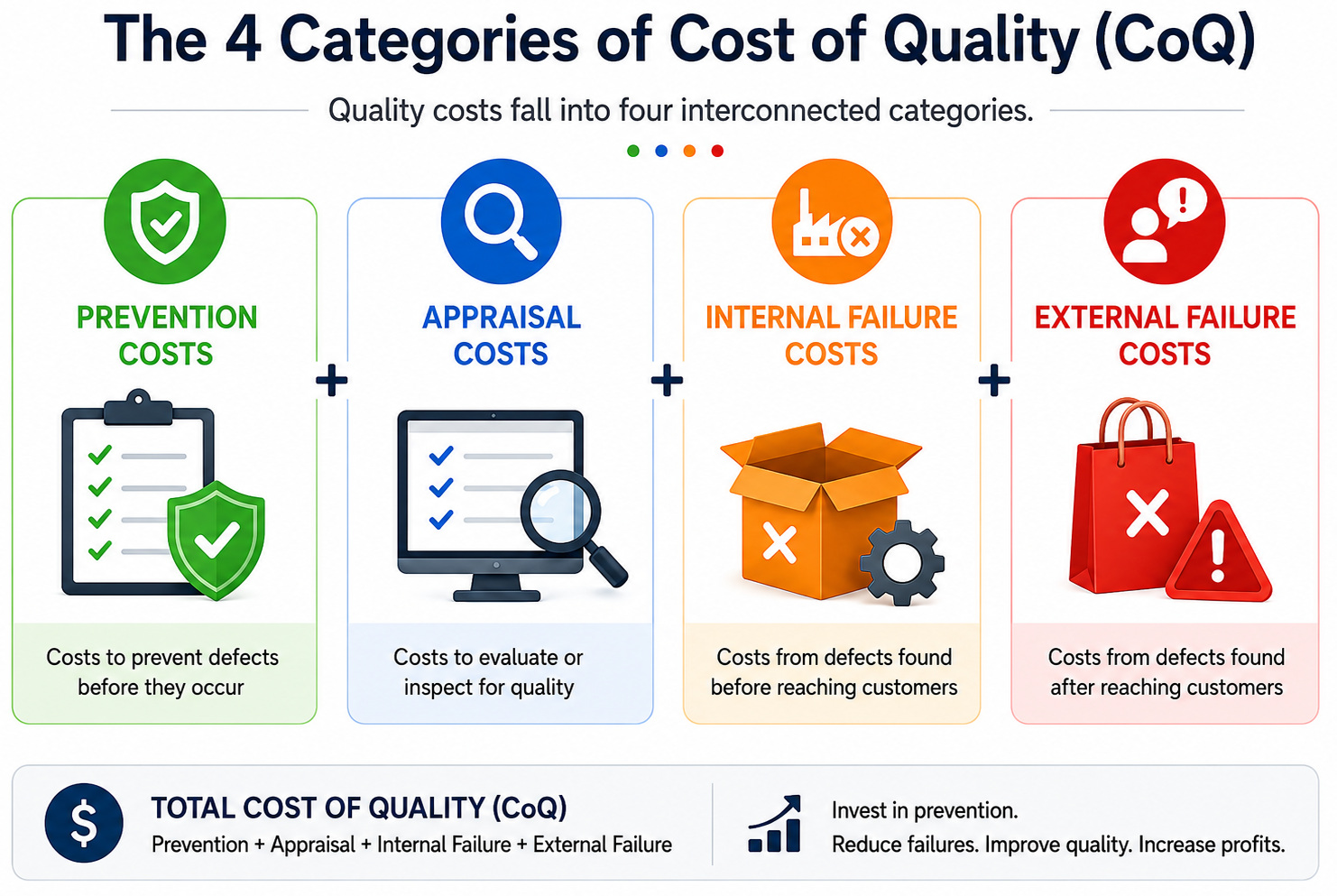
Cost of Quality is divided into four categories, also referred to as the P-A-F model. These categories are deeply interconnected.
Prevention Cost
This is the first category. They are investments made by the organizations to prevent defects before they take place. This includes employee training, process standardization, supplier evaluations, preventive maintenance, and quality planning. Prevention costs are proactive. Their objective is to bring down variability and prevent issues at the source.
Appraisal Cost
The second category includes tasks used to verify if products or services meet quality standards. Testing, inspection, audits, code reviews, and calibration all come under this category. Appraisal activities do not stop defects directly, but they help detect issues before customers encounter them.
Next comes the failure costs.
Internal Failure Costs
These occur when defects are caught before products are shipped to customers. Rework, scrap, debugging, downtime, and production delays are all common examples of it. These failures remain within the organization, but they still use significant resources.
External Failure Costs
This is the last category, and is often the most painful. These occur when customers catch defects after delivery. Warranty claims, recalls, legal disputes, refunds, and reputation damage are all part of this. External failures are expensive as they impact both operational costs and customer trust at the same time.
Read: What is the Testing Trophy Model?
The Business Impact of Poor Quality (CoPQ)
Poor quality rarely impacts only one department. A single defect can influence operations, finance, customer support, marketing, and sales simultaneously.
- Lower productivity
- Higher operational costs
- Employee frustration
- Customer churn
- Slower growth
Over time, these issues compound, which is why companies with strong quality cultures often defeat competitors financially. Their operations become more predictable, customer retention improves, and fewer resources are wasted correcting avoidable mistakes.
Quality, in many ways, becomes a competitive edge.
How to Calculate Cost of Quality in Software Development
While CoQ originated in manufacturing, it has become more important in software engineering.
Modern software teams invest more in prevention and appraisal activities because fixing problems after release is way more expensive.
Cost of Good Quality (COGQ) refers to the costs incurred to ensure that products or services meet quality requirements and prevent defects from occurring. What is the investment made to build quality into processes and products?
Cost of Poor Quality (COPQ) is the total cost incurred when products, services, or processes fail to meet quality requirements on the first attempt.
In simple terms, it is the money a company loses due to mistakes, defects, rework, waste, customer complaints, and failures.
CoQ = Cost of Good Quality + Cost of Poor Quality
CoQ = Prevention Costs + Detection Costs + Internal Failure Costs + External Failure Costs
What makes this model powerful is the realization that spending more on prevention often brings down the much larger costs associated with failures.
Take, for example, a developer catches a bug during coding and fixes it immediately. The cost is minimal.
Now imagine the same issue reaches production:
def calculate_discount(price, percentage):
 return price - (price/percentage)
Initially, the function may seem correct. But mathematically, the discount calculation is wrong. The formula should multiply the price by the percentage, not divide it.
The corrected version would be:
def calculate_discount(price, percentage):
 return price - (price * percentage / 100)
If this bug sneaks into production in an e-commerce application, thousands of customer transactions could be affected. The company will lose revenue, issue refunds, patch systems urgently, and handle customer complaints. This is all because of a small defect that could have been prevented much earlier through testing or code review.
This is a good demo of a core principle of Cost of Quality:
The later a defect is discovered, the more expensive it becomes.
That is why software teams invest in automated testing, CI/CD pipelines, peer reviews, monitoring systems, and DevOps practices.
Read: What is Quality Software Testing Tool.
Conclusion
Companies need to be proactive about handling the cost of quality and invest heavily in prevention and appraisal costs. This helps reduce the exposure to both internal and external failure costs.
The companies that succeed long-term are usually not the ones that spend the least on quality. They are the ones who understand where quality investments create the greatest operational and financial returns.
Whether in manufacturing, software development, healthcare, or service industries, the lesson remains the same:
Preventing defects is almost always cheaper than fixing them later.
Frequently Asked Questions (FAQs)
- What is the main goal of Cost of Quality (CoQ)?
The main purpose of Cost of Quality is to calculate how much an organization spends on maintaining quality and how much it loses due to poor quality. It helps businesses catch inefficiencies, reduce defects, and improve profitability.
- What is the P-A-F model?
The P-A-F model is basically the four categories of CoQ:
- Prevention Costs
- Appraisal Costs
- Internal Failure Costs
- External Failure Costs
- Why is prevention cost important in CoQ?
Prevention costs help organizations stop defects before they happen. Investing in training, process improvement, and quality planning usually reduces expensive failures later in the production or delivery cycle.